Ego Time: Dandies in the Press

We’re not ones to fluff our own egos. We have plenty of admirers to do that for us. However, once in a while the redoubtable Junta at D.net enjoys what can only be described as a perfect storm of kudos. This stretch of inclement weather has occurred in the last few months or, as the business types say, between the beginning of Q4, 2011 and the end of Q1, 2012.

It’s well known, of course, that our founder, Christian Chensvold, made it big in Japan with an eight page spread in the oddly-named style mag “Free & Easy.”

But, really, the big winner in the blogeratti kudos contest was decidedly Robert Sacheli, the Washington D.C. clubman-about-town who pens the occasional – and more than occasionally erudite – column, “The Passionate Spectator” herein.

On a junket to New York late last Autumn, your correspondent met Bob and Chenners at the delightfully haute-bohemian Coffee House Club on 44th Street’s club row. (Bob is a member and past president of the Arts Club of Washington, and the Coffee House is a reciprocal. If you don’t know what that means you are reading the wrong website.) There we had a delightful lunch among its charming membership. (Try the salmon. It’s divine.) Bob was looking smart but casual in a second-hand – we are not above that sort of thing around here, you know – Brioni sport coat and scarf.

After lunch, Bob wended his way down to the Village, where he was to meet with the fashion illustrator Richard Haines. On the street, he was stopped in his tracks by a photographer who snapped the picture above. This turned out to be a one Steffen Hendlund, who runs a style blog called “A Way of Dressing.”

Bob duly got his portrait drawn by Mr. Haines, right, here in a Richard James tweed hacking-style jacket with an orange velvet collar.

Earlier this year Bob was pigeonholed at a book party in D.C. for flowered shirt enthusiast and “Gay Men Don’t Get Fat” author, Simon Doonan. The shots (below) are from the GoKateShoot blog of D.C. photographer Kate Warren.

(more…)

Officially Unofficial: The Dandyism.net Armorial Achievement

Dandyism.net now has an officially unofficial armorial achievement, commonly referred to as a “coat-of-arms”—you can read about the all tedious distinctions and exact terminology for yourself  here if you are so inclined.

Why “officially unofficial?”  Because, as noble as D.net is, it has not petitioned, nor will it likely ever be granted, a patent from either the College of Arms of England or the Court of the Lord Lyon in Scotland. In these countries flashing the D.net achievement may put you at risk of getting the equivalent of a parking ticket from the heraldry police. Fair warning.

Never mind. We’re Americans—or at least three-quarters of the D.net Junta are—and are therefore free to append any image, tagline, motto, brandmark or what-have-you to our website that we choose.

Regardless of the legal niceties, the achievement, designed by redoubtable D.net contributor, heraldry buff, sartorial entrepreneur and style blogger, Bill Thompson, follows all the rules pertinent to the art and science of heraldry. The blazon, the written description that is the heart of any armorial achievement, reads as follows:

Gules, a coney Ermine saltant, an otter Ermines rampant contourné victualled Or, a chief wavy of the last guttèe du vin, a gillyflower Vert. Crest, an antique Eastern crown, a peacock close Proper. Mantled the first and Argent. Motto: “Chaque homme un roi.”

Within all this seemingly Harry Potter-esque lingo resides sound reasoning for each charge. The coney, or bunny rabbit, is sometimes a prankster but otherwise lives a quiet and peaceable life, while the otter is dining out (“victualled”) and living life to the fullest. Both are tinctured in luxuriant fur—ermine, once reserved only for royalty. The wavy partition connotes flânerie, while the chief, or field above, is  “scattered with drops of claret.” The “gillyflower vert” is as close an approximation of Oscar Wilde’s green carnation as the ancient rules of heraldry will allow. The peacock peeking out of the crown speaks for itself. What could be more dandiacal?

The motto, chaque homme un roi, roughly translates to “every man a king,” and harkens back to the life of Beau Brummell. (In case you’re worried, faithful myrmidons, our new motto may be chaque homme un roi but our venerable tagline remains “insufferably bored since 1802.”)

It occurs to us that our coney, our otter and our peacock will want names of their own. Have any ideas? Leave them in the comments. If we choose one or more of your names we’ll send you a D.net armorial achievement-themed keepsake.

Announcement

In recognition of Mr. Thompson’s exemplary service to Dandyism.net, the Junta is pleased to announce his elevation from faithful myrmidon to the august position of Minister of Protocol and Pursuivant of Arms, with all the rights and privileges thereunto.

And that’s official.

Wild Dandyish Rose: Six Questions for Rose Callahan

Hugo Jacomet of Parisian Gentleman, Paris. Courtesy, Ross Callahan.

Rose Callahan is notable for, among other things, her work in creating The Dandy Portraits, in which she catalogs the “lives of exquisite gentlemen today”—contemporary dandies and modern retro-eccentrics alike. Ms. Callahan’s commitment to outstanding men’s style, as well as her eye for detail and superior photography, prompted Dandyism.net to get in touch with her and ask a few questions.

Ms. Callahan is a native of San Francisco—an increasingly rare thing nowadays. She studied photography at the venerable California College of the Arts, founded in 1907 by Frederick Meyer, one of the lodestars of the California Arts and Crafts movement. Ms. Callahan shares a legacy with such West Coast luminaries of aestheticism as Gillette Burgess (founder of The Lark), Willis Polk and Bruce Porter. It’s no wonder she has such an acute sense of the minute details of her craft, or that she was called “the most amazing woman on the planet” by the authors the Fine and Dandy Shop’s weblog.

Ms. Callahan tells us she was inspired to take up photography at an early age by her mother, who was passionate about the art. Her early heroes included Man Ray, Brassai, George Hurrell, Robert Frank, Bruce Davidson, Helen Levitt, Diane Arbus, Mary Ellen Mark and Hollywood glamor portraits.

As a freelance photographer, Ms. Callahan shoots portraits and fashion plates for clients such as Grey, McCann-Eriksson, Scholastic, Random House, the Gilt Groupe and so forth. Recently she has been creating short films at her own Rarebit Productions, focusing on her favorite subject, the exquisite gentleman. She is currently collaborating with journalist Nathaniel Adams on a book proposal for The Dandy Portraits. She now lives in New York City.

Winston Chesterfield of Le Vrai Winston,  London. Courtesy Rose Callahan.

Michael Mattis: When did you first hear the word “dandyism?” How did you react to it?

Rose Callahan: I don’t ever recall not knowing the word, but my understanding of it must have come from watching reruns of BBC shows on public TV.  It was usually in context of “he’s a bit of a dandy,” meaning or insinuating somewhat of an eccentric English gentlemen, but with a rakish quality, and of course, a sharp dresser. The Kink’s song “Dandy” was definitely also part of my awareness of the term.

(more…)

Who’s the Dandy?: Oscars Edition

You can’t watch the Academy awards. Not in person, in any case, unless you’re a seat-filler. It’s by invitation only, to Academy members, and the Academy determines the guest list. So how do you get to be a member of the Academy of Motion Picture Arts and Sciences? Why, your name is endorsed by your Academy branch’s executive committee, then you are sponsored by two existing Academy members, and membership is by invitation of the Board of Governors. So when it seems like the judging criterion is a bit biased, that’s because it is, thank you very much. And if you don’t like it, well, we’ll just pass you over for membership this year.

But they do throw a heck of an awards show. Actually, they throw four, but only one is televised; because who wants to see overweight, balding technicians get Oscars for Science and Technology?

The Oscars is supposed to be a classically formal affair. Dinner dress has been the norm, but full dress has not been unheard of. (On the Awards Parade Formality Continuum, the Academy Awards fits in somewhere between the snooty Tonys and the extravagant Golden Globes.) Before we go further, let’s set the bar high with Kirk Douglas at the Oscars in 1950. That’s how it’s done.

No one opted for dress suits at this year’s Oscars. Well, host Billy Crystal tried. (No, Zach Galifianakis and Will Farrell, presenters in all-white dress suits and cymbals, don’t count.) Billy Crystal’s suit was just awful. The jacket was cut well enough, but everything under it was four shades of wrong. White tie is an exacting mistress who will not tolerate tepid commitment. Crystal could tell something was wrong, too; he seemed uncertain and ill at ease wearing it. It seemed as if the clothes themselves shamed him into dressing down into a less-distracting dinner suit for the second half of the show. That’s too bad, really; Crystal’s age and gravitas have grown him into the role of Oscars host, one who should be able to confidently wear proper white tie. The brash young outsider joking his way through the show has matured into a latter-day Bob Hope, who gives the Oscars the self-deprication it so desperately needs to be accessible to Joe America, and keep it from sinking into a self-congratulatory event for Hollywood insiders who take themselves far too seriously.

(more…)

Silently Stylish

We don’t care if Brad is in Black Label, Clooney is clad in Valentino or if Woody shuffles down the red carpet in Reeboks. The actor we’ll be watching most closely at Sunday’s Oscarfest is a fictional one: George Valentin.

Well, more accurately Jean Dujardin, the actor portraying him in “The Artist.” Concocted from a picture-perfect mix of swash (think Douglas Fairbanks, Sr., as Robin Hood, Zorro or the Black Pirate), smolder (his near-namesake Valentino in anything), and the endearingly silly (think Gene Kelly as Don Lockwood in full “Dueling Cavalier” mode), Dujardin’s performance as the eponymous artist has propelled him from well-known Gallic farceur to sensational international leading man in true Old Hollywood style.

And style, in fact, has more than a little to do with his ascendance. (Take a look at him doing some major smoldering of his own on the cover of this month’s French GQ, suave in «un smoking» by Armani.) While critics point to his fizzy physical comedy, his loving embodiment of stars of a bygone era or that nifty pencil mustache, we think they’re silently barking up the wrong tree.

The buzz in the D.net screening room has more accurately nailed the secret of Dujardin’s (and George’s) screen success: This is a guy who can truly work a set of tails. In fact, we can’t remember any performer since Astaire for whom a full-dress suit has done so much—and vice versa.

(more…)

Dueling Dandies: How Men Of Style Displayed A Blasé Demeanor In The Face of Death

In literature, dandyish characters occasionally find cause to duel. Sword in hand, Mikhail Lermontov’s dandyish, Byronic hero, Pechorin, fights a duel on a cliff’s edge in order for the loser’s death to appear accidental when he falls. Pushkin’s fictional dandy, Eugene Onegin, is another to have taken to the field of honor when he tragically slays his friend, Lensky. And who could forget the elusive Scarlet Pimpernel.

A “wrist of steel,” with style

While fictional dandies can be found on the page crossing swords or exchanging pistol shot, can the same be said for stylish men in real-life history? Historical dandies are known as idlers by nature, or as Charles Baudelaire once put it, “A dandy does nothing.”  Perhaps, then, the living and breathing dandy does not seem to be the most suitable person for pursuing things like fencing, shooting, and dueling. But appearances can deceive.

As with most duels, this one begins with an insult. Writing in his column “Pall-Mall Semaine,” Raitif de la Bretonne, nom de plume of Jean Lorrain (whose real name was Paul Duval), singled out another young writer by the name of Marcel Proust.  Lorrain had written a review of Proust’s first novel Pleasures and Days. Among Lorrain’s criticisms, he found Proust’s work, “… elegiac spinelessness…” He thought it full of “tenderness, vain, inane flirtations, and pretentious in style…” He then went on to write of Proust’s private affairs. He hinted at Proust having an affair with M. Alphonse Daudet’s son, Lucien, and that Daudet might write a future preface for Proust as a result of this affair.

Lorrain and Proust no doubt ran in some of the same circles. The two men shared many acquaintances, such as fellow traveler Robert de Montesquiou; so perhaps Lorrain did have intimate knowledge of Proust’s private trysts. While this may be true, Proust certainly didn’t want his private life bandied about by Lorrain for all to see. Proust, obviously and rightly incensed, demanded satisfaction.

Before petit dejeuner? Sacrebleu!

It may be difficult to imagine Proust, with his celebrated asthma, throwing down the gauntlet at the feet of Lorrain, but that is exactly what he did. He rose to the occasion in a manner which may seem uncharacteristic of the gentle, meticulous, Hercule Poirot-like Proust many believe they know. His friend Reynaldo Hahn testified in his journal that Proust “shows a coolness and firmness, for three days prior to the duel, which seem incompatible with his nerves, but does not surprise me at all.” Proust was earning the respect of his peers. When it came to being insulted, Proust stood his ground. He must have felt some pride in doing so for, at a later date, when critics had made insinuations about his character, Proust would frequently point to this moment in his history. In 1904 he wrote to Robert de Montesquiou, “I remember when I fought with M. Lorrain, a time when I had not yet set the day, but I was already there in my morning coat, ready, my only concern was that the duel did not take place before noon.”

We see the sangfroid of an idler whose only concern was to not have to get up too early.

(more…)

Who’s the Dandy?: Super Bowl Edition

Last Sunday, February 5, the people of the United States over-indulged in their annual ritual of rough spectacle, the Super Bowl. American football, which somehow split from its English parent, Rugby Football, in the 19th century, has become the American institution nonpareil, as much a religion as a sport. As a game, it combines brute force, military-style battlefield strategy and, occasionally, physical poetry.

But the Super Bowl is more than the ultimate season-ending championship game. It’s America’s “barbaric yawp,” an over-the-top, overtly commercial, Roman-style imperial pageant (as Madonna’s show at half-time more than casually suggested).

Even those Americans who don’t like football watch the Super Bowl. Why? The commercials. Since Apple’s famed “1984” spot first burst onto the scene during Super Bowl XVII, the game has been used as a canvas one which the world’s top advertising agencies and brands show off their finest “art.”

Among this year’s Super Bowl ads was this one from Gillette, maker of shaving apparatus.

The ad, called “Masters of Style” features:

Adrien Brody, the Hollywood man about town and star of the triple Oscar award-winning film, The Pianist.”

Gael García Bernal, steamy Latin lover and lead in such romantic comedies as “A Little Bit of Heaven.”

André 3000, singer-songwriter, member of the hip-hop duo “OutKast,” and creator of the “Benjamin Bixby” line of 1930s, college-inspired clothing.  (You’ve seen him here before.)

Well, what about it? Who’s the Super Bowl dandy? One? None? All? Or should there be a flag on this play? Let us know in the comments.

Born Talese

Born on 7th February 1932, today Gay Talese celebrates his 80th birthday—a suitable moment to pay tribute to this most admirable of American dandies with a Dandyism.net Lifetime Achievement Award.

Talese is, of course, best known as a journalist and one of the initiators of the “New Journalism” that arose in New York during the 1960s. Along with contemporaries such as that other noted journo-dandy, Tom Wolfe, he pioneered a form of writing that fused factual details with eloquent storytelling, an approach that remains influential to this day. Indeed, he has been called “the most important non-fiction writer of his generation.”

Though it is as a dandy rather than a writer that we wish to celebrate Talese today, there are certain comparisons to be drawn.

Significantly, he has been criticized for taking too much time and care over his writing. Doubtless some would accuse him of taking too much time and care over his dressing. But as he has said: “You’d think people should be criticized for not taking enough time and doing a sloppy job.”

(more…)

Libérte, Egalité, Elégance: The Politics of Style

An enameled American flag pin mounted on the notched lapel of an inoffensively bland dark-blue suit. That’s the sad snapshot of fashion’s influence in American politics today.  D.net’s house style historian and Washington bureau chief Robert Sacheli casts a fascinated glance at an era when politics and fashion were seen as equally vigorous­—and intertwined—male pursuits. Forget snooze-inducing ties, ‘80s anchorman haircuts, and sleeveless sweaters on would-be presidents (permanently, please). Travel with Sacheli to an era when dressing for political success required a cravat, classical curls, velvets, and a mighty fierce walking stick.

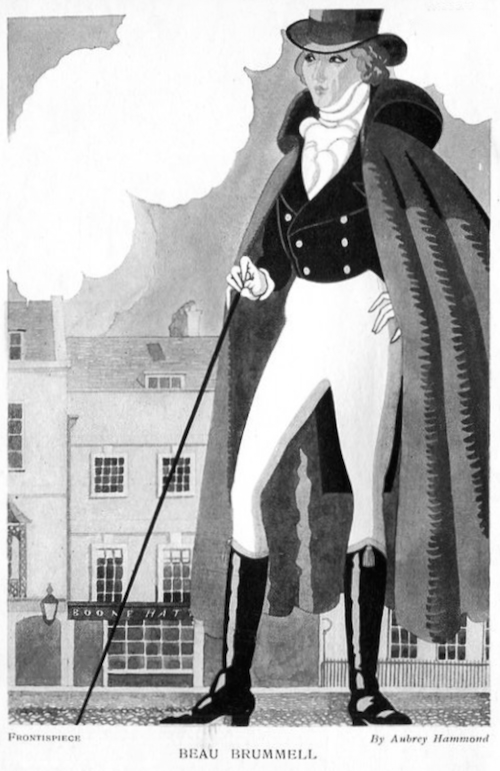
Waterloo may have been the site of Napoleon’s ultimate tumble, but his imperial ambitions suffered a kick in the breeches on a more intimate but equally decisive field of battle: Beau Brummell’s dressing room.

That’s the view of design historian Paula A. Baxter, who sees the duel between British and French men’s styles as a major influence on early 19th-century cultural history. For Baxter, a writer and adjunct professor of humanities at Berkeley College’s White Plains, N.Y., campus, it’s also just one reminder that the confluence of fashion and politics neither began nor ended with the Che Guevara T-shirt — and that it’s a sphere in which dandies have long exerted their elegant influence.

Dandies “have been around since antiquity,” said Baxter in a phone interview, and they’ve been “always acknowledged and appreciated. They were accepted with head-nodding encouragement — ‘Oh, yes, he’s a bit of a dandy’.” For Baxter, the list begins with Julius Caesar and extends through the centuries, encompassing a few intriguingly speculative entries (“Voltaire could have been a bit of a dandy”). For these protodandies, the aristocracies of style and intellect contributed as much to their influence as any political power.

In a former professional incarnation as curator of the Art and Architecture Collection of the New York Public Library, Baxter mined the library’s treasures to mount an exhibition titled “A Rakish History of Men’s Wear” a few years ago. She also explored one of the most tumultuous periods in political and fashion history in “When Rakes Ruled: French Masculine Dress of the Revolutionary Era,” a cover feature in Antiques magazine.

Talking to her about that article’s themes elicited insights on the social impact of men’s fashion, spiced by some beau monde gossip 18th-century style. If Anna Wintour presided over a graduate history seminar, she’d sound a lot like Baxter — though not quite as irreverent.

Dressing for revolution

“I completely got Marie Antoinette,” says Baxter of director Sofia Coppola’s portrait of the queen as a tragic fashionista. The Bourbon aristocracy was “really mindless, and the bitterness that built up to explosion [in the Revolution] had to be something profound. Clothing was a red flag of social and financial inequity, and the whole notion of fashion was a hot-button issue” for a nation whose ruling class was living — and dressing — in quite another world as the rest of the populace.

Paris under Louis XVI provided all the dangerous and sensational ingredients for revolution in both fashion and government. “The real drama of 18th-century life was playing out in Paris,” a city that Baxter finds was a crucible for the modern metropolis in which money, class, celebrity, and politics were driving forces of urban life. It was a magnet for the ambitious: “Political figures from the provinces such as Danton and Saint-Juste came to the capital” to make their mark.

Fashion periodicals emerged here during the last quarter of the 18th century, growing in influence and reach among a sophisticated audience of upper-class and aristocratic readers, particularly men. One of the most influential, Gazette des salons: Journal des dames and les modes, was edited by a defrocked priest, Pierre de La Mésangère. It surveyed men’s and women’s fashions and found rich material for social commentary in a Paris that “was street theatre every day,” says Baxter.

There was much for de La Mésangère (“a very canny man, a quite remarkable person [who] kept a keen eye on everything”) and his fellow fashion scribes to cover, as men’s styles became one of the most visible monitors of social change. The ancien régime’s male costumes were as rigid and codified as its court etiquette: coat, waistcoat, and knee-length breeches were the unvarying elements. As disenchantment with the Bourbons grew by the late 1770s, ruling-class fashion also lost its appeal for aristocrats such as the Petits-Maîtres, or élégants, who turned to what Baxter describes in her article as  “elaborate dress and ambiguously libertine morals” and used fashion-forward British trends in men’s wear as the basis for their ensembles. (A decade or so earlier, London’s Macaronis had shown their well-turned-out backs to the establishment by dressing in exaggerated version of French court fashions.)

Periodicals had “a recoil effect as fashion crossed the Channel between France and England,” says Baxter, and British style — and one style maker in particular — would have a profound influence on how French men dressed in the next decades. Young Parisians took up the tailored lead of their London counterparts, as the more restrained and refined style anglaise, with its allusions to the squire and the sportsman, came to the fore.

Dress became less about broadcasting status though opulent display. Instead, the philosophies of fashion and government shifted to emphasize the importance of the individual. The idea of democracy was on the rise in the tailor shops as well as the political salons of Paris.

Liberating men — and their legs

The Jacobin journalist Jean-Paul Marat was among the many Revolutionary leaders who found aristocratic fashion morally repellent, and his call for a more democratic approach to dress, based on styles appropriated from the working classes, was echoed by activists seeking wider social reforms. Eventually, fashion and freedom would become inextricably intertwined, most powerfully symbolized by a pair of pants.

(more…)

Gieves Hawked

When serendipity knocks you have to be there to answer the door.

It was a while ago when serendipity gently scratched like a hopeful paramour. Bored one afternoon I had gone to see a movie matinee at the independent Clay Theater up in the “nice” part of Fillmore Street in San Francisco. The film was what my father would call “a cute little movie;” not a blockbuster shoot-‘em-up by any means, but rather a nicely put together character study. “The Great Buck Howard” stars John Malkovich and includes a brace of cameos by Tom Hanks, who also produced it. The movie deals with an eccentric TV psychic, loosely based on the real life story of The Amazing Kreskin, who appeared on the Tonight Show with Johnny Carson dozens of times. It’s a good renter.

Anyway, after the film I decided to stroll across the street to The Junior League of San Francisco Next-to-New Store. As even the most lackadaisical boulevardier should be able to surmise, the Junior League is one of those tony, old-money institutions that benefit a plethora of causes which, luckily for the organization, never seem to improve enough so that the League’s charity can ever be turned down.

As a deadbeat dandy, I’ve had a certain amount of luck at the Junior League shop in the past, finding articles such as cast-off Dunhill ties and never-worn Church’s English shoes. That day I started at the suit and sport coat rack, flicking through it with my usual, speedy, “Nope-flick, nope-flick, nope-flick.”

I looked around and spied a second, free-standing rack next to the one I’d been flicking through and went to take a look. My hand alighted on a soft wool navy blazer. I pulled it out. It was double-breasted, four-on-six, with three buttons on the cuffs and no vents. It had conservative shoulders. I looked more closely. The gold-colored buttons bore the stamp, “G&H.”

I could feel my palms beginning to sweat.

(more…)

New Year, New Dandyism.net

Faithful myrmidons will have noticed that two new articles have recently been posted to the D.net homepage, our “Dandy of the Year”—which is more like “Dandy of the Every Other Year” at this point—and a piece on our former leader and ongoing inspiration, Christian Chensvold (blessings and peace be upon him) and his success in the ephemera of Japan. These are but a mere amuse-bouche for what is to come. On the slate are original monographs, profiles, interviews, book and museum reviews and much more. Stay tuned.

In addition, we’ve made some changes to the masthead:

Michael Mattis takes over as Grand Poo Bah, charged with the thankless but not entirely unrewarding tasks of Managing Editor and Forum Moderator. We encourage new viewers to become Forum myrmidons, and lapsed myrmidons to re-engage in the conversation. There is no entry fee and you have nothing to declare but your genius. We think you’ll like the changes. If you would like to try your hand at the quill and contribute an original article to the D.Net home page, please join the Forum and send Mattis a private message.

Florida gentleman and neo-royalist homme d’affaires, Sean Charles Hall, is our new Social Media Manager and Cruise Director. Hall created and now curates our elegant page on Facebook. There you’ll find a veritable boîte à bijoux of dandiacal imagery, bons mots, and exquisite conviviality.

Stewart Gibson has been named, sotto voce, as D.net’s Editor, Ephemera. For some time, the London boulevardier has been charged with the exclusive responsibility of making sure that there are three or four new Ephemera links each week.

And while you’ve been cramming so that you can pass the definite Test of Dandy Knowledge— finals are next week, gentlemen—more texts have been added to the Library.

(more…)

It’s Official: Dandyism.net Founder is Big in Japan

Dandyism.net founder and erstwhile editor-in-chief, Christian “Chenners” Chensvold has cracked the code that lies at the four-point crossroads of contemporary dandyism, trad, preppy and Ivy League style—in Japan. He was recently profiled in the Japanese magazine, Free & Easy.In 2008, Chensvold founded Ivy-Style.com, a website devoted to the Ivy League look, its history and its place in American—and, indeed, international—culture. Two years ago, Chensvold pulled up his California stakes and moved his operation to New York, to be nearer the epicenters of publishing, culture and style. There he met classic men’s style greats like G. Bruce Boyer and Richard Press. And Ivy-Style.com thrived. Recently, he was appointed an editorship at the venerable New York high society magazine, Quest.

(more…)

Dandy of the Year: Luca Rubinacci

My eyes first fell upon Luca Rubinacci while exploring Scott Schuman’s website The Satorialist.  I can still remember being quite impressed by Luca’s use of color. “Now that is how you dress boldly,” I said to myself. I must admit that I thought nothing more about him for some time afterwards. Then one day as I flipped through the pages of my favorite men’s magazine, The Rake, there staring back at me was that same stylish individual from several months earlier. I recognized instantly the same style, and once more I was taken by his bold use of color, his beautifully fitted bespoke clothing, and the distinct originality that he projected. I was so impressed with what I saw on those pages that I actually took the time to read the entire article, something which I’ll admit that I rarely have time to do. Come to find out, Luca Rubinacci is a very interesting man whose style exemplifies his originality—in his clothing, his work, and his lifestyle, all of which help him cut the dandyish figure.

(more…)

Balzac’s Treatise on Elegant Living

Balzac’s “Treatise on Elegant Living” was recently given its first English translation by the newly founded Wakefield Press. I wrote this essay on it for the latest issue of The Rake.

Lessons in Elegance: The words of wisdom contained within Honoré de Balzac’s “Treatise on Elegant Living” remain pertinent almost two centuries after their initial publication
By Christian Chensvold
The Rake, issue 10

Every era has its particular expression of elegance. But while that expression is forever in flux, the principles that govern it are fixed and eternal. So argues Honoré de Balzac in his “Treatise on Elegant Living,” a breezy philosophic tome written in 1830 recently given its first English translation by Wakefield Press, a small new publisher in Cambridge, Massachusetts devoted to rare and forgotten works of European literature.

The “Treatise on Elegant Living” brims with timeless aphorisms that transcend the ever-changing guise of fashion. Take, for example, the following evergreen gem: “Good has but one style; evil a thousand.” For Balzac, a few of the thousandfold manifestations of sartorial evil include any outfit that bears excessive ornamentation or a profusion of colors. Then there’s what in the fashion industry is called “working a look,” an act of folly whose sin is meretriciousness. “Anything that aims at an effect,” pronounces Balzac, “is in bad taste.”

(more…)

Dandy in the Otherworld: In Memory of Sebastian Horsley

Michael Mattis, who has previously written about Sebastian Horsley for Dandyism.net, offers this remembrance.

Dealing with death is always a hard thing. Dealing with the death of someone you have written about is harder still — especially when what you have written about the deceased is not all that nice.

Frequent readers of Dandyism.net will be well within their rights to expect us to slam Sebastian Horsley even in death. But they will be disappointed. For one thing, it does not fall within the purview of a gentleman to speak ill of the dead. What follows is, rather, a grudging appreciation.

First, the facts: According to news reports, the body of Sebastian Horsley, 47 —artist, writer entrepreneur and showman — was found at about 11:00 A.M. GMT on Thursday, June 17, in his small apartment in Soho, London, by one of his lady friends. He had apparently died of an overdose of heroin.

A few evenings before, Horsley had seen the play about his recalcitrant life, based on his memoir, “Dandy in the Underworld.” The play was written by Tim Fountain. It was to be made into a film, produced by his friend, the actor, writer and director Stephen Fry of “Wilde” and “Jeeves” fame.

(more…)