Theory

Balzac’s Treatise on Elegant Living

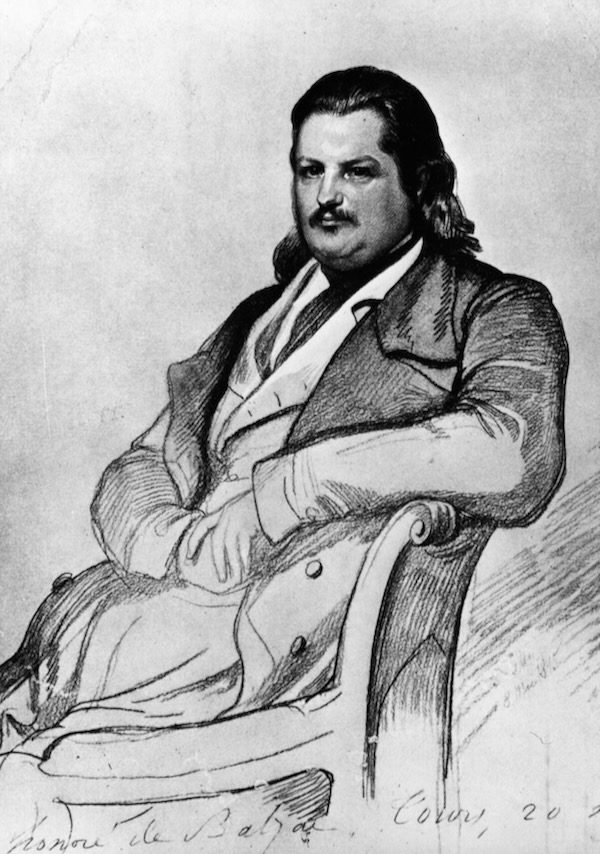
Balzac’s “Treatise on Elegant Living” was recently given its first English translation by the newly founded Wakefield Press. I wrote this essay on it for the latest issue of The Rake.

Lessons in Elegance: The words of wisdom contained within Honoré de Balzac’s “Treatise on Elegant Living” remain pertinent almost two centuries after their initial publication
By Christian Chensvold
The Rake, issue 10

Every era has its particular expression of elegance. But while that expression is forever in flux, the principles that govern it are fixed and eternal. So argues Honoré de Balzac in his “Treatise on Elegant Living,” a breezy philosophic tome written in 1830 recently given its first English translation by Wakefield Press, a small new publisher in Cambridge, Massachusetts devoted to rare and forgotten works of European literature.

The “Treatise on Elegant Living” brims with timeless aphorisms that transcend the ever-changing guise of fashion. Take, for example, the following evergreen gem: “Good has but one style; evil a thousand.” For Balzac, a few of the thousandfold manifestations of sartorial evil include any outfit that bears excessive ornamentation or a profusion of colors. Then there’s what in the fashion industry is called “working a look,” an act of folly whose sin is meritriciousness. “Anything that aims at an effect,” pronounces Balzac, “is in bad taste.”

Full of wit and wisdom, the “Treatise” is the kind of book every boulevardier should keep in his armoire and read a passage from each morning before getting dressed. It is a breviary for the dandy-aesthete who sees life as an art project, and for those who see style is an existential imperative, who feel a burning need to leave their mark everywhere they go and on everything they do. Such acolytes of style will find a perfect mantra in Balzac’s line “Elegance dramatizes life.”

Elegant living consists of nothing less than the perfection of material life, the development of grace and taste in everything that belongs to and surrounds us. It’s a quixotic endeavor that few men are capable of reaching completely, and some not at all.  “Retailers, businessmen, and teachers of the humanities,” Balzac decrees, “fall outside the scope of elegant living.” The “Treatise” is thus not just an exploration of elegance, but an argument for a life of leisure. This may be difficult to swallow if you’re a wannabe fais neant who’s forced, by cruelty of fate, to work for a living.

But time and money aren’t Balzac’s only prerequisites for elegant living. So are certain innate qualities that destine a man, from the moment he enters the world, to one day cut a dashing figure. “To distinguish our life through elegance,” Balzac writes, “one must still have been endowed with that indefinable faculty that always prompts us to choose truly beautiful or good things.”

That draconian necessity — to have been endowed — exemplifies Balzac’s rhetoric at its most rigidly elitist. For while elegance is something that is practiced daily —  “A man must practice this science with the same ease with which he speaks his mother tongue,”  he writes, for “It is dangerous to stammer in the elegant world” — it is also something, like any other talent, that only a select few are born with. “A man becomes rich,” is the book’s best-known quote, “he is born elegant.”

Of course, man is also born naked: Clothing is what makes him civilized. And one should never underestimate the importance of wearing clothes, something everyone does and yet so few do elegantly. “Clothes are the most tremendous modification social man has experienced,” writes Balzac; “they influence all of existence.”

SELECTED APHORISMS

Elegant living is, in the broad acceptance of the term, the art of animating repose.

The man accustomed to work cannot understand elegant living.

It is not enough to become or to be born rich to lead an elegant life: one must feel it.

Though elegance is less an art than a feeling, it is also the result of instinct and habit.

Retailers, businessmen, and teachers of the humanities fall outside the scope of elegant living.

Anyone who does not frequently visit Paris will never be completely elegant.

Studied elegance is to true elegance what a wig is to hair.

Anything that reveals thrift is inelegant.

Clothing does not consist so much in clothes as in a certain manner of wearing them. Consequently it is not the rags in themselves as it is the spirit of the rags that one must grasp.

The boor covers himself, the rich man or the fool adorns himself, and the elegant man gets dressed.

People Are Strange: Chensvold on Eccentrics

vogue-11.jpgLast month my editor at L’Uomo Vogue emailed me with the subject heading “Urgente!” She asked me to write the introductory essay for the upcoming issue, whose theme was “eccentricity.” She needed 800 words, and I could take any approach I wanted. The deadline was 24 hours.

I figured every Italian writer on their roster must have been on a six-week summer vacation if they were forced to resort to me at the last minute. Still, I felt honored.

Well the issue is out and my piece isn’t exactly the intro to the issue: Instead, they made in the back-page essay and slapped the word “Opinion” over it. Well, it certainly is.

But hey, there are 350 pages, and I’ve got the last word.

Below is the English original. It’s less musical than the Italian translation, but at least there are paragraph breaks.

Everyone/No One Is Eccentric
By Christian Chensvold

I once met a fashion writer who was dressed in red pants, pointed shoes and a kind of military jacket that looked straight from the cover of the Beatles’s “Sgt. Pepper’s Lonely Hearts Club Band.” But most noticeable about him was his waxed handlebar mustache.

He was about 25.

During our conversation, the young man repeatedly used the word “eccentric,” but not to describe someone who sleeps hanging upside down like a vampire bat because they find it more effective than Ambien, but to refer to certain acquaintances and their fashion sense, which was carefully calculated to look outlandish.

“Eccentric” is one of those words that in common usage has lost nearly all its denotative meaning. It has also shed its more quaint and rarified connotations. “He’s a bit of an eccentric,” used to suggest the person referred to was erudite and rich in addition to slightly odd. An innocent victim of our era of subjectivity and relativism, “eccentric” now means whatever the speaker wants it to mean, ceaselessly shifting based on context. And increasingly “eccentric” has come to mean just another lifestyle choice.

Decades of global democracy, mass media saturation and egalitarian ideologies have all contributed to the dilution of the concept of eccentricity, a moniker so charming when used to refer to an English aristocrat, yet so pathetic when applied to a suburban Californian trying to live out the fantasy that he’s a pirate.

The true definition of an eccentric, of course, is not just one who behaves oddly, but one for whom it would never occur to behave otherwise. In its purest form, eccentricity is wholly unconscious. But as soon as “eccentric” behavior becomes a kind of deliberate performance used for self-promotion and publicity, or for gaining attention, whether positive or negative, we are not dealing with genuine eccentricity, but something ersatz. Instead of being delightfully oblivious to his own oddities, the “eccentric” is a calculating showman seeking a reaction from his audience. If the true eccentric is a private individual who hides his idiosyncrasies, the ersatz eccentric is a public poser who flaunts them. (more…)

Social Vs. Literary Dandyism

frontis01_full.jpgThe split between the dandyism of clothes and the dandyism of words is the subject of our most recent Library addition: “Social and Literary Dandyism,” published in Littell’s Living Age in 1880.

In its rambling way, Littell’s unsigned article compares the purely social dandy — the Beau Brummells and Poodle Bings — with his literary counterpart.

“Dandies, like saints, are never much beloved of their fellow-creatures,” states the anonymous author. “Like saints, they have an ideal perfection in manner and dress, and ideals are felt to be impertinent. To be a dandy is to outrage the vanity of every one who has not the energy to be wakefully attentive to details of deportment and costume. The great dandies of old says, like Brummell, Lauzun, and the rest, were everywhere welcomed because they made themselves disagreeable to so many people.”

The author goes on to say, “A young man is never more certain of social success than at the moment when most other young men never mention him without saying that they ‘would like to kick him’.”

But as goes social life, so goes its literary counterpart. “Literary dandyism is also excessively annoying to the rugged hodmen of letters,” notes the author. “These industrious persons detest the literary dandy, the man who minds his periods and regards the cadence of his sentences, and shuns stock illustrations and old quotations, as the social dandy avoids dirty gloves and clumsy boots.”

The anonymous author names several men whom he considers literary dandies, including Balzac, Arnold, Pater, Walpole, Sydney, and even Machiavelli and Plato himself. Yet he was more prescient that he could ever have imagined. Just a few years after the publication of “Social and Literary Dandyism,” Oscar Wilde would burst onto the scene, first as an international lecturer on aestheticism and eventually as the author of some of the English language’s most elegant comedies of manners.

Many years later, a young journalist named Tom Wolfe — a man who donned his white suits, he said, for the express purpose that they pissed off “industrious persons” — would help reinvent literary non-fiction. Both were roundly kicked by the inelegant hearties of the prose world in their respective day. Yet both show that dandyism, whether personal, social or literary, involves clever balance of artifice and being true to oneself.

Music For Choosing A Buttonhole

dbtuxpeakcopy8qn.jpg(Achtung: The music files in this post are NOT set to play automatically. If they do, please alter your browser preferences so that media files play only on command).

Recently a forum member posed the question “What sort of music does a dandy listen to?” While the unanimous answer was “Whatever the hell he likes,” in this post I’ll alter the question to “What sort of music is dandyish?” and offer a suggestion.

At Dandyism.net headquarters, when performing particularly arduous editorial duties, there is one genre of music I turn to for inspiration: British Light Music. While some might call it elevator music, I prefer to think of it as grand staircase music.

British Light Music consists of light orchestral music for things like ballets, films and plays. The emphasis is on melody. It is largely a 20th-century invention and therefore has developed alongside — though completely aloof from — the total dismantling of tonality by composers of serious music.

Besides the virtues of effortless elegance and a certain mischievous quality, British Light Music is wholly scorned by serious musicologists since it’s based on pretty melodies. It therefore has the added appeal of being a musical pariah proudly flying the banner of beauty over the shelled trenches of atonality.

I find the music especially appealing in the morning, as I could never listen to something like a Shostakovich quartet before lunch. It is also especially pleasant to listen to in the evening while choosing a boutonniere for a night at the opera.

My own collection is small but cherished. The following are a few of my favorite tunes.

First up is “The Boulevardier” by Frederic Curzon. No lollygagging flaneur this fellow: Just listen to that brisk pace as he marches down the avenue to give his tailor an earful of the ol’ rancid:

(more…)

Dead C Scrolls

deco.jpgTen years ago D.net was a mere glint in his diabolical monocle, yet even then webmaster Christian M. Chensvold had a vision of restoring the misunderstood, much-maligned dandy to his rightful place in society.

So he chose the two-hundredth anniversary of Brummell’s resignation from the dragoons to publish his pseudo-scholarly, teacup-shattering interpretation of dandyism.

Like a dapper gent charming his way into parties he wasn’t invited to, Chenners had been insinuating articles on dandyism into obscure publications since the age of 24. There was Cochran’s, a regional antiques newspaper for the Sonoma Wine Country, and Victorian Decorating & Lifestyle, a magazine for Anglophile housewives that went under in 2002, fueled by the rise of Ikea.

At age 27 Chensvold began dating a Deco Belle and was able to talk his way into the pages of The Sophisticate, the journal of the Art Deco Society of California, with an article on Deco-era dandies.

A year later an expanded version of the story ran on Retroactive.com. Unfortunately the site soon disintegrated into the Internet ether, sucking the seminal article along with it.

However, for a time the site was one of the top-five “dandyism” results on Internet search engines, so it’s no surprise that several passages soon thereafter appeared verbatim in a certain Brit’s breezy instruction book on the topic, without so much as a tip of the homburg.

And so Chensvold’s mini-masterpiece joined the statue of Zeus at Olympia and the dodo bird among mankind’s lost treasures — that is until now.

Through advanced technology, we were able to retrieve this Dead C Scroll of Dandyism.net, which we now present for your edification and amusement. We have corrected typos and made it conform to the D.net Manual of Style, but otherwise the text appears as it did 10 years ago.

We also found a photo of what Chensvold looked like during the article’s composition. He is pictured above stepping away from his desk for a cup of coffee.

Originally planned as a trilogy, the article was hastily expanded to four parts to mollify a cranky homosexual who complained that the first three parts neglected gay dandies. Though Noel Coward and Harold Acton were featured prominently, the reader was no doubt miffed that Chensvold thought their sexual orientation completely irrelevant to their dandyism.

The article gives priceless insight into D.net’s conception, not to mention the stories we’ve been recycling for the past three-and-a-half years. It’s also worth pointing out the earnest and fervent tone of the prose (note debt to Barbey in several turns of phrase), compared to the cynical, cold and ironic tone Chensvold espouses today.

 He has certainly evolved into a true dandy.

(more…)

The Fake’s Progress

horsley.jpgEvery era gets the dandies it deserves.

The Regency got Brummell, a true sartorial innovator whose wit was as crisp as his country-washed linen. Count D’Orsay alleviated Victorian stuffiness with his manly charm, and the Edwardian Era was graced by Saki and Max Beerbohm, who all but reinvented the rapier wit. The Deco era had thoroughly modern Noel Coward, Lucius Beebe appeased Atomic Age anxiety with quaint anachronism as well as a poisoned pen, and the big-money ’80s saw the rise of another dandy satirist, Tom Wolfe.

Though they had different personalities and temperaments, these great dandies all shared certain qualities, including style, wit, aplomb and often a mild eccentricity. Many also enjoyed some measure of celebrity — how should we have known them otherwise? And while some dandies of the past certainly enjoyed their fame, the artists among them put their work first and did not pursue celebrity for its own sake. “L’homme est rien,” said Flaubert. “L’oeuvre est tout.”

But who in our present era is celebrated for his dandyism? When the words “dandy” and “dandyism” appear in print, what names are written in conjunction with them? Who, in the eyes of the media and public, are the successors of Brummell, D’Orsay and Beerbohm?

In a 2006 article, The Guardian attempted to answer these very questions. Published in light of Ian Kelly’s Brummell biography and the BBC miniseries “This Charming Man,” the article cites as Brummell’s successors, among others, two pop stars: Brian Ferry, a self-proclaimed “pimpernel” who, the author gushes, “now wears Prada, Hedi Slimane and Kilgour,” and Sean “P. Diddy” Combs, whose “ghetto fabulous” look consists of “jeans and $10,000 worth of jewelry around his neck.”

Others recently celebrated as dandies in the press include Combs’ former umbrella-carrier-in-chief, Fonzworth Bentley (real name Derek Watkins), OutKast frontman André 3000 (real name Benjamin) — whose tailored Duke of Windsor/Harlem Renaissance-inspired duds have lately given way to outfits more conducive to farming than strolling boulevards — British rock star Pete Doherty, who dresses like an Amish notary, and Patrick McDonald, whose penchant for cosmetics at times makes him look like Liza Minelli.

(more…)

Drag Strip

Dandyism recently made a jaunty appearance at New York Fashion Week. Unfortunately it was on the runway of a women’s fashion show.

Ralph Lauren’s Spring 2008 ready-to-wear collection showcased a number of outfits echoing Brummell and Beerbohm:

recut-1.jpg recut-2.jpg

The ensembles are bound to rekindle the vexed question of whether women who raid men’s closets are really dandies, or merely females in drag.

(more…)

The Jockey Horror Picture Show

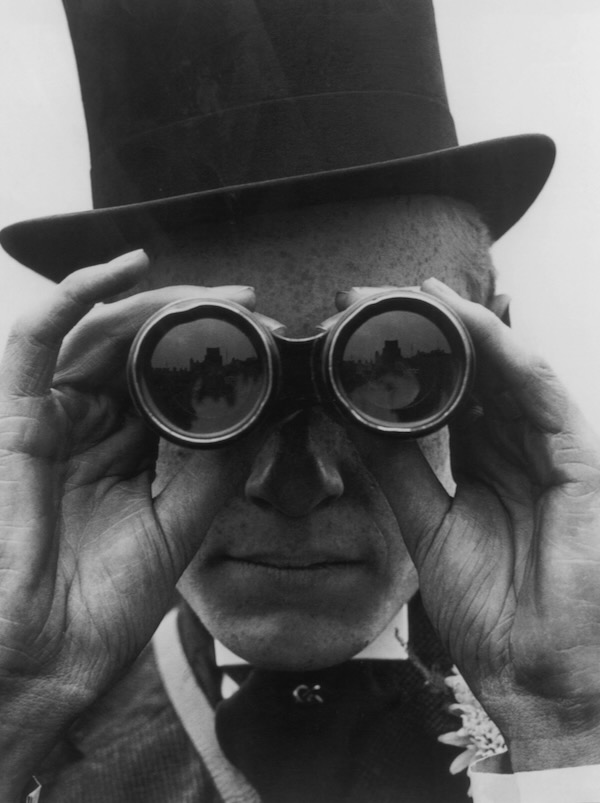
copy-of-manet-bar-at-the-follies.jpgWebmaster Chenners recently made the acquaintance of the anonymous top-hatted and mustachioed gent at left. It was at a press conference at the Getty Museum in Los Angeles, and the gent was lounging within the four-cornered confines of Edouard Manet’s “Bar at the Folies-Bergere,” which is being exhibited on the West Coast for the first time.

The swell in question is a mirrored reflection in the upper right corner of the painting. He is also a sterling artistic depiction of the French Jockey Club dandy, and set us to musing about this often neglected dandy sub-species.

Baudelaire purported to describe the type in “The Painter of Modern Life” when the splenetic poet was really describing his ideal of the artist as social critic.

Actually, the Jockey Club dandy was the true successor of the Regency dandy: sporty, masculine, socially prominent, and understated in his apparel. His reign lasted from the 1830s until the outbreak of World War I. The Prince de Sagan and Boni de Castellane are two of the finest examples. Baudelaire, although he praised the type in print, avoided them in life. Montesquiou, although one of them by birth, loathed them.

Their reputation received a dire stain as a result of the infamous Charity Sales Bazaar fire on May 4, 1897. Over 140 persons died, mostly women and children. None were dandies, however: It was reported that Jockey Club members used their walking sticks to bludgeon women and children out of the way to make their escape.

In dandy history, the Jockey Club dandy has been unjustly overshadowed by the intellectual dandy of Barbey and Baudelaire, and the aesthetic dandy of Montesquiou. There’s virtually nothing written about him in English; the great dandy-ologist Ellen Moers ignores him entirely. There are, however, several excellent studies in French. And of course there’s Proust.

(more…)

Lording Over Others

johnrobrussell.jpgDandyism is the result of the spontaneous combustion of personality and attire. The desired effect is ignition, not detonation. You want to make an impression on others, not a spectacle of yourself.

So avoid being heavy-handed with any of dandyism’s core elements, even something as rare today as elegance.

It may seem odd to caution against elegance in an age when flip-flops and tank tops are ubiquitous. But in our daily Internet searches for signs of dandyism to occasionally praise and mostly deride, we find that nominal dandies tend to dress in a way that shouts “Behold my splendor!” like a carnival barker. Their putative refinement receives further amplification by the assumed title of “Lord,” “Sir,” et cetera.

Therefore, D.net has enlisted the laconic opinions of a real patrician — John Ian Robert Russell, 13th Duke of Bedford — to act as a corrective. The duke was admittedly a bit dodgey, penning four books for the masses about how to be an aristocrat, selling the ancestral estate, and, worst of all, laboring as a journalist.

Yet he is simpatico with our notion that understatement is the key to making an aristocratic impression, so he must know what he is talking about.

(more…)

For a Microbian Dandyism

By Francois-Xavier d’Arbonneau de la Bachellerie

Perhaps because of our Proustian and Balzacian education, we have been convinced for years that dandyism as we know it from literature and history has disappeared from our modern world. The more we study it, the more we believe that current pretensions to dandyism are egalitarian claims. No matter if it is based on historical misconceptions or ends a semantic tradition of Mignons, Petits-Maîtres, Beaux, Lions, Macaronis, Incroyables, Muscadins, Bucks, Bloods and Dandies, the point is to persuade provincial readers of fashion magazines and conspicuous consumers that they can enter Brummell’s genealogy. (more…)