Balzac’s Treatise on Elegant Living
Balzac’s “Treatise on Elegant Living” was recently given its first English translation by the newly founded Wakefield Press. I wrote this essay on it for the latest issue of The Rake.
Lessons in Elegance: The words of wisdom contained within Honoré de Balzac’s “Treatise on Elegant Living” remain pertinent almost two centuries after their initial publication
By Christian Chensvold
The Rake, issue 10
Every era has its particular expression of elegance. But while that expression is forever in flux, the principles that govern it are fixed and eternal. So argues Honoré de Balzac in his “Treatise on Elegant Living,” a breezy philosophic tome written in 1830 recently given its first English translation by Wakefield Press, a small new publisher in Cambridge, Massachusetts devoted to rare and forgotten works of European literature.
The “Treatise on Elegant Living” brims with timeless aphorisms that transcend the ever-changing guise of fashion. Take, for example, the following evergreen gem: “Good has but one style; evil a thousand.” For Balzac, a few of the thousandfold manifestations of sartorial evil include any outfit that bears excessive ornamentation or a profusion of colors. Then there’s what in the fashion industry is called “working a look,” an act of folly whose sin is meritriciousness. “Anything that aims at an effect,” pronounces Balzac, “is in bad taste.”
Full of wit and wisdom, the “Treatise” is the kind of book every boulevardier should keep in his armoire and read a passage from each morning before getting dressed. It is a breviary for the dandy-aesthete who sees life as an art project, and for those who see style is an existential imperative, who feel a burning need to leave their mark everywhere they go and on everything they do. Such acolytes of style will find a perfect mantra in Balzac’s line “Elegance dramatizes life.”
Elegant living consists of nothing less than the perfection of material life, the development of grace and taste in everything that belongs to and surrounds us. It’s a quixotic endeavor that few men are capable of reaching completely, and some not at all. “Retailers, businessmen, and teachers of the humanities,” Balzac decrees, “fall outside the scope of elegant living.” The “Treatise” is thus not just an exploration of elegance, but an argument for a life of leisure. This may be difficult to swallow if you’re a wannabe fais neant who’s forced, by cruelty of fate, to work for a living.
But time and money aren’t Balzac’s only prerequisites for elegant living. So are certain innate qualities that destine a man, from the moment he enters the world, to one day cut a dashing figure. “To distinguish our life through elegance,” Balzac writes, “one must still have been endowed with that indefinable faculty that always prompts us to choose truly beautiful or good things.”
That draconian necessity — to have been endowed — exemplifies Balzac’s rhetoric at its most rigidly elitist. For while elegance is something that is practiced daily — “A man must practice this science with the same ease with which he speaks his mother tongue,” he writes, for “It is dangerous to stammer in the elegant world” — it is also something, like any other talent, that only a select few are born with. “A man becomes rich,” is the book’s best-known quote, “he is born elegant.”
Of course, man is also born naked: Clothing is what makes him civilized. And one should never underestimate the importance of wearing clothes, something everyone does and yet so few do elegantly. “Clothes are the most tremendous modification social man has experienced,” writes Balzac; “they influence all of existence.”
SELECTED APHORISMS
Elegant living is, in the broad acceptance of the term, the art of animating repose.
The man accustomed to work cannot understand elegant living.
It is not enough to become or to be born rich to lead an elegant life: one must feel it.
Though elegance is less an art than a feeling, it is also the result of instinct and habit.
Retailers, businessmen, and teachers of the humanities fall outside the scope of elegant living.
Anyone who does not frequently visit Paris will never be completely elegant.
Studied elegance is to true elegance what a wig is to hair.
Anything that reveals thrift is inelegant.
Clothing does not consist so much in clothes as in a certain manner of wearing them. Consequently it is not the rags in themselves as it is the spirit of the rags that one must grasp.
The boor covers himself, the rich man or the fool adorns himself, and the elegant man gets dressed.
Last month my editor at L’Uomo Vogue emailed me with the subject heading “Urgente!” She asked me to write the introductory essay for the upcoming issue, whose theme was “eccentricity.” She needed 800 words, and I could take any approach I wanted. The deadline was 24 hours.
Today marks the five-year anniversary of Dandyism.net.
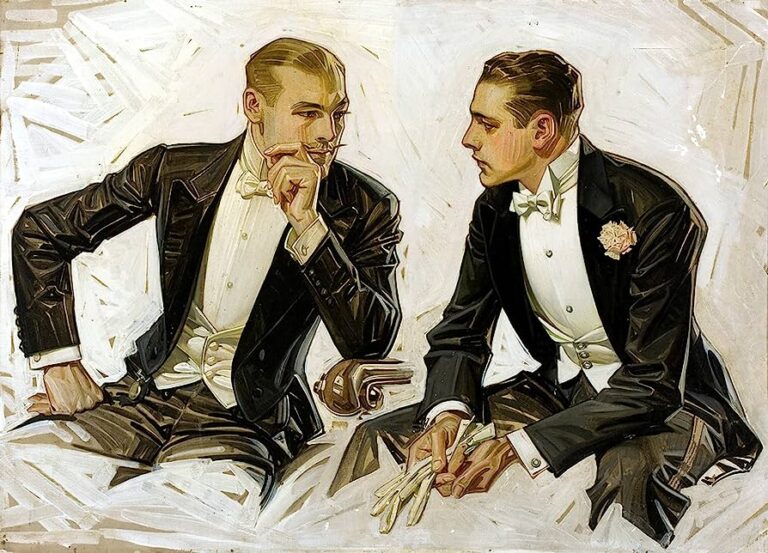
Since Dandyism.net’s beginnings, we’ve shamelessly raided the oeuvre of American artist J.C. Leyendecker to illustrate our posts. In the early days, before our scowling mascot was created, we used a Leyendecker image next to the site’s logo. Currently, we use Leyendeckers to illustrate the notorious “
Astute readers likely noted the clothing Chenners wears in the photo spread in the recent
(Achtung: The music files in this post are NOT set to play automatically. If they do, please alter your browser preferences so that media files play only on command).
Following hard upon Robert Sacheli’s three-part biography on Lucius Beebe, D.net founder Christian M. Chensvold has written
During my apprenticeship of the dandy art, I’ve learned that dandyism is not defined by a specific look from a certain era, but instead is an approach to wearing clothes, independent of time and place, that produces an effect we call dandyism. There is no one way to dress like a dandy, only ways that succeed or fail to varying degrees. And nowhere is the attempt to adopt a standardized dandy uniform more futile than in the attempt to replicate the way dandies dressed a hundred years ago.
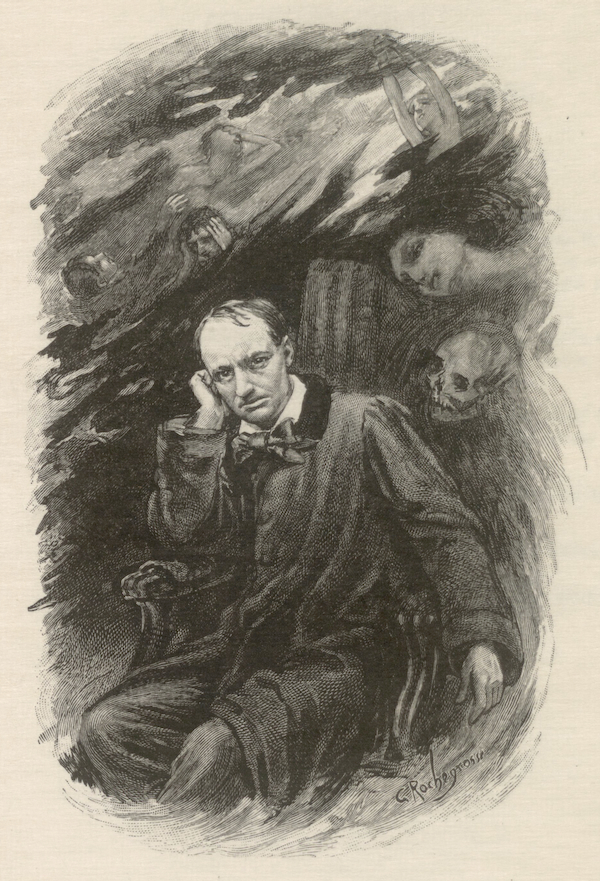
“La chair est triste, helas, et j’ai lu tous les livres.”
Ten years ago D.net was a mere glint in his diabolical monocle, yet even then webmaster Christian M. Chensvold had a vision of restoring the misunderstood, much-maligned dandy to his rightful place in society.