A Dandy in Embryo

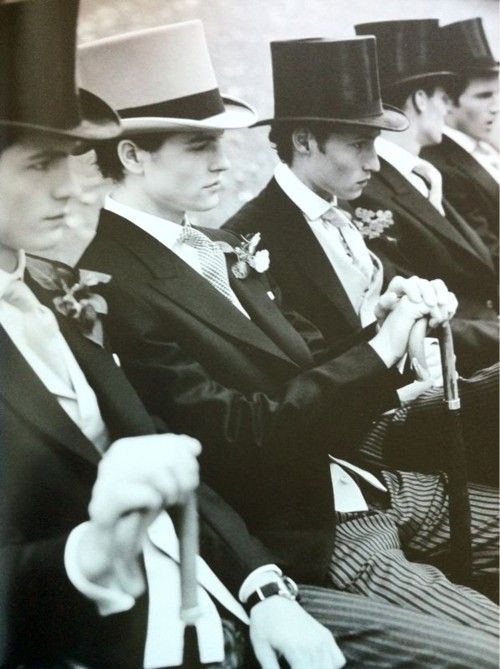
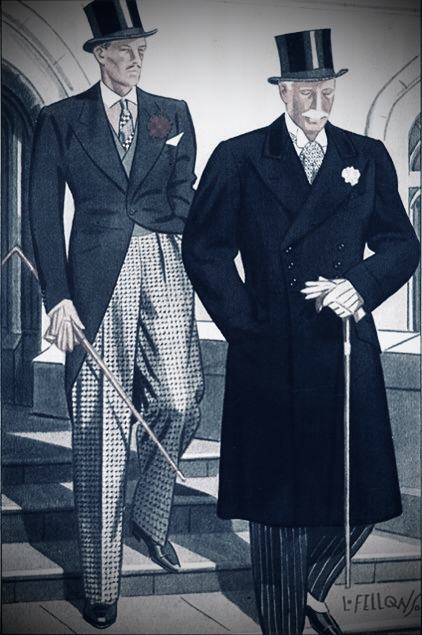
Eton, 1947.

Eton, 1947.
If politics make strange bedfellows, the strangest must be the dandy and the politician.
Yes, there is a long tradition of political dandyism from Alcibiades to William Pitt, Benjamin Disraeli, Sir Samuel Hoare and Anthony Eden in Britain, and the young Theodore Roosevelt, Jimmy Walker, and former Congressman Adam Clayton Powell Jr. in the United States.
But we wonder if this tradition can withstand scrutiny. Disraeli became a successful politician only after he put his green velvet trousers, canary-colored waistcoat and lace shirts in mothballs. Walker, on the other hand, remained a dandy, but his casual approach to governing eventually forced him out of office.
On a more profound level, how can one square the politician’s naked ambition for power and the need, in modern democracies, to cater to the masses with the dandy’s nonchalant superiority?
One man, though, who has been a successful politician for decades and whose style we’ve always admired is San Francisco’s Willie Brown.
Thirteen years after he resigned as Speaker of the California State Assembly — an office he held for an unprecedented 15 years — and more than four years after his tenure as San Francisco’s mayor ended, Willie Brown remains one of the most powerful men in California politics. He is also one of the world’s best dressed men.
A Texas native, Brown came west, arrived in San Francisco in 1951, age 17. He was met at the station by a dapper uncle, he relates in his new memoir, “Basic Brown: My Life and Our Times,” who took one look at the country-dressed youngster and immediately took him shopping. Brown’s been a clothes-wearing man ever since.
Brown’s politics, like those of his predecessors is built on “juice” — that most dandyish form of soft power that works entirely through personality, influence and connections and operates at the highest levels of society. And Brown is nothing if not a social butterfly. Though now in his 70s, rare is the evening when he doesn’t have two or three high-toned engagements lined up, and he still spends his Friday afternoons at the window table at Le Central, talking, drinking and playing dice with socialites like Harry de Wildt and his long-time haberdasher, Wilkes Bashford.
Partly through his old friend, the late Herb Caen — who dubbed him “Da Mayor” and called him “Hizzoner” — and partly through his own charisma, Brown developed a relationship with the press that was the envy of his political colleagues and the scourge of his rivals.
“The only thing worse than being misquoted,” he once said, channeling Oscar Wilde, “is not being quoted at all.” Continue »
When Oscar Wilde arrived in the United States, he said, “I have nothing to declare but my genius.” When Sebastian Horsley arrived, he said, “I have nothing to declare but Oscar Wilde’s genius,” and was promptly sent back to England.
In March of this year, on tour promoting his book “Dandy in the Underworld,” Horsley — who’s known, in addition to having himself crucified in the Philippines, for his facility with putting a clever twist on established witticisms — was denied entry in the US on grounds of moral turpitude. It was the crowning achievement of the Bush Administration.
For the past 200 years, notoriety has always clouded the dandy: gambling debts, sex scandals and garden-variety egomania have always formed the shadow cast by the man of taste and wit. But with Sebastian Horsley’s various addictions — heroin, prostitutes, himself — this happy breed reached a new low.
In addition to his ghastly taste in clothing and penchant for spouting theoretical nonsense, Horsley broke a cardinal rule in the history of dandy literature: From Barbey and Baudelaire to Beerbohm and Wilde, dandy authors write about dandyism; they do not write about themselves as dandies.
But perhaps Horsley’s greatest distinction is that not one member of the D.net staff felt obligated to read his book.
And for that, Dandyism.net awards Mr. Horsley the title 2008 Dandy of the Year.
Photo by Moritz Steiger.Â
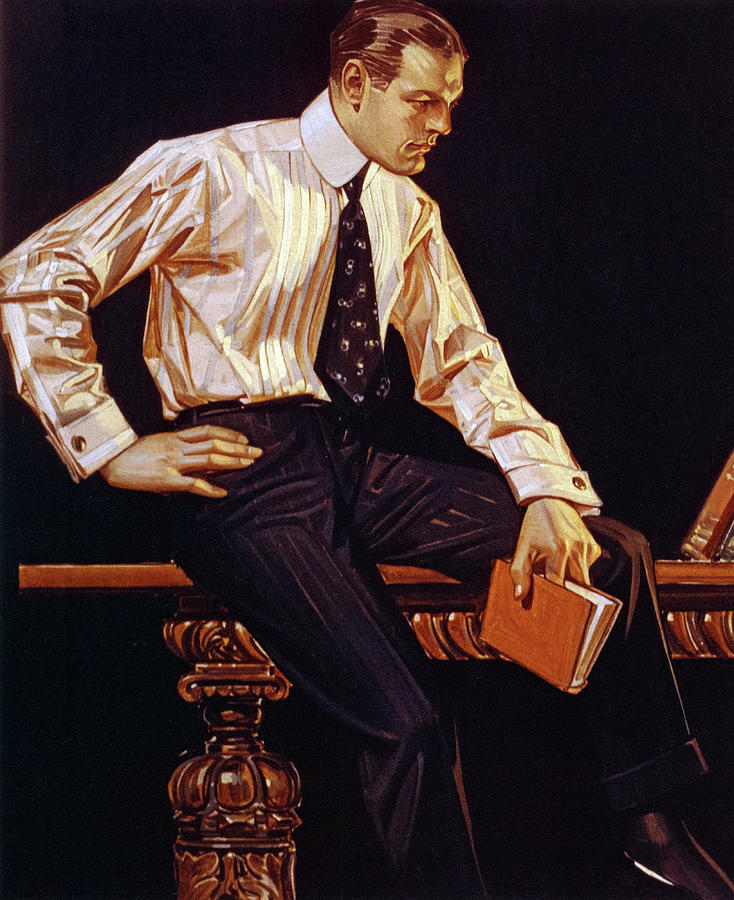
Since Dandyism.net’s beginnings, we’ve shamelessly raided the oeuvre of American artist J.C. Leyendecker to illustrate our posts. In the early days, before our scowling mascot was created, we used a Leyendecker image next to the site’s logo. Currently, we use Leyendeckers to illustrate the notorious “How Dandy Are You?” quiz, as well as the “Test of Dandy Knowledge.”
We’ve always seen in Leyendecker’s images a singular sartorial elegance, patrician demeanor, a certain frostiness, and a rock-solid masculinity. Naturally it took a gay man to create such images.
Now we can finally post Leyendecker images without shame, thanks to a nihil obstat from the publisher of the new book “J.C. Leyendecker,” by Laurence and Judy Cutler.
It all came about as a result of D.net webmaster Christian Chensvold’s profile of the artist for the online magazine at RalphLauren.com. Writes Chenners:
In 1905, Leyendecker created his most memorable legacy, leaping from the purely visual to the powerfully symbolic. In an age when detachable shirt collars were de rigeur, Leyendecker’s Arrow Collar Man—a mascot for the menswear company Cluett, Peabody & Co.—became what Cutler calls the first real advertising campaign and produced the first sex symbol of either gender.
In a campaign lasting twenty-five years, Leyendecker portrayed an archetypal American masculinity that was equal parts football hero and urbane man-about-town. Whether clutching a briar pipe or guiding a winsome debutante across the dance floor, the Arrow Collar Man embodied a vision of American manhood that was both rugged and refined—every woman’s dream. “At one point,” says Cutler, “Leyendecker’s Arrow Collar Man got more fan mail than Rudolph Valentino.”
Below are a few more images from the artist, all courtesy of Abrams Books, via American Illustration Gallery, NYC. Continue »
Recently a reader known as Dr. Bathybius left a comment on Michael Mattis’ post “Life’s Not Fair.” The comment was a piquant one, and as the post was no longer the lead, we feared the comment would go unseen, and that all hell would not break loose. So we contacted the poster, expressed our interest in running his comment as its own post, and requested a photograph of himself in his finery. In exchange, we gave our dandy word of honor (admittedly not worth much) that we would not editorialize at his expense, such as by wondering aloud, for example, whether he is one of the founders of International Talk Like a Pirate Day. The doc agreed, in exchange that we fix his embarrassing typos.
And so we present a mini-essay from a genuine retro-eccentric (and LiveJournal blogger), pictured at left in an exclusive photo for D.net.
It seems there is a war between the GQ-Dandies and the Bohemians/Décadents of which I was previously unaware! Well then, “…into the breach! …every man-jack of you!” I had thought that refinement of experience (sartorial or otherwise) was the order of the day (callow youth that I was). But, alas, after taking the ‘How Dandy are you’ quiz, I realize that I am already pre-reviled by your elite fashion cadre as an eccentric, an oddity and perhaps even (dare I say it?) a clown! This is most especially distressing in that Mr.Mattis belongs to the same confraternity in SF that we (Mr. Seeley and myself) do. Has he forgotten his scandalous San Franciscan roots? The name of this organization he well knows, but I’ll not mention it here (to protect all relevant parties).
Like all divergent species, we each have a common set of ancestors, whether Brummell, Baudelaire or Barbey d’Aurevilly. Let us find some solace or unity in that. If not, let the martial horns blare, and I shall gird my loins for doing battle with misguided and effete miscreants arguing over the number of tassels that the ideal ox-blood tinted loafer should be festooned with (2 tassels too staid? 3 tassels completely outré?). Let the tyranny that the sack suit has exerted over the 20th century be laid waste, and a more enlightened time dawn where the male homo sapiens has yet more radiant plumage than his crypto-gynocratic mate. After all, I would rather be a comical lion fighting on my feet, than a pallid, navel-gazing fashion-lemur like Tom Wolfe, in his Antebellum, white-washed, pseudo-”Slave-Owner” togs, carefully cogitating the rarefied alchemy that is the “two-olive martini,” all the while genuflecting at the altar of tepidness.
“Braccae illae virides cum subucula rosea et tunica Caledonia-quam elenganter concinnatur!”
Gentlemen, I remain your assiduous nemesis ever,
REA3     8¬}D-
P.S. Young Mr.Seeley is an actual friend of mine. Please consider him my second at the duel.
When Bathybius submitted his photo, he offered the following:
The suit (if you’re curious, or a fact-collector) is bespoke as tailored by Favourbrook of Jermyn Street, (Saville Row/Picadilly), London:
http://www.favourbrook.com
Again, my reason for commenting in the first place is to bemoan the fact that Dandyism seems to become a more and more restricted definition with time. Where is the splendor of current male sartorial fashion? Whenever I see yet another stereotypical navy blue blazer with brass buttons, I muse, “Where are the explorers? Where are the new frontiers? Can one re-purpose the fashions of the past (with modifications/updates) to create new taste-pleasing forms? More highly refined aesthetics?” Admittedly, I freely embrace the Décadent/Symbolist, Belle Époch/Mal du Siècle aesthetic, which would not be everyone’s choice, but I am speaking more of method than of matter.
As a guide to this line of inquiry, I would point to the following publication, which is at least a sign-post of what I am aspiring to (whether I am successful at it or not, one has one’s ideal and one must do what one is capable of doing in realizing said ideal):
“The Man of Fashion: Peacock Males and Perfect Gentlemen” by Colin McDowell.
Well enough of my prattling…
My warmest felicitations to you and Dandyism.net.
Rather than becoming more perceptive and informed over time, mainstream articles on dandyism get stranger and stranger — even the ones we’re quoted in.
The latest entry is from Quest magazine, a luxury city mag from New York.
The article in question quotes Chenners at least as accurately as previous articles have, while charting “the evolution of dandyism from Oscar Wilde to Justin Timberlake.”
Yes, you read that correctly.What’s more, personae used to illustrate the article include model Giselle Bundchen, designer Kris van Assche, and other creative choices.
The split between the dandyism of clothes and the dandyism of words is the subject of our most recent Library addition: “Social and Literary Dandyism,” published in Littell’s Living Age in 1880.
In its rambling way, Littell’s unsigned article compares the purely social dandy — the Beau Brummells and Poodle Bings — with his literary counterpart.
“Dandies, like saints, are never much beloved of their fellow-creatures,” states the anonymous author. “Like saints, they have an ideal perfection in manner and dress, and ideals are felt to be impertinent. To be a dandy is to outrage the vanity of every one who has not the energy to be wakefully attentive to details of deportment and costume. The great dandies of old says, like Brummell, Lauzun, and the rest, were everywhere welcomed because they made themselves disagreeable to so many people.”
The author goes on to say, “A young man is never more certain of social success than at the moment when most other young men never mention him without saying that they ‘would like to kick him’.”
But as goes social life, so goes its literary counterpart. “Literary dandyism is also excessively annoying to the rugged hodmen of letters,” notes the author. “These industrious persons detest the literary dandy, the man who minds his periods and regards the cadence of his sentences, and shuns stock illustrations and old quotations, as the social dandy avoids dirty gloves and clumsy boots.”
The anonymous author names several men whom he considers literary dandies, including Balzac, Arnold, Pater, Walpole, Sydney, and even Machiavelli and Plato himself. Yet he was more prescient that he could ever have imagined. Just a few years after the publication of “Social and Literary Dandyism,” Oscar Wilde would burst onto the scene, first as an international lecturer on aestheticism and eventually as the author of some of the English language’s most elegant comedies of manners.
Many years later, a young journalist named Tom Wolfe — a man who donned his white suits, he said, for the express purpose that they pissed off “industrious persons” — would help reinvent literary non-fiction. Both were roundly kicked by the inelegant hearties of the prose world in their respective day. Yet both show that dandyism, whether personal, social or literary, involves clever balance of artifice and being true to oneself.
On September 17 I had the pleasure of speaking on Lucius Beebe at the Coffee House, one of Beebe’s own clubs. It’s a bastion of a vanished Manhattan, an outpost of the bohemian artists-and-writers world of the 1920s and ’30s. It’s still governed by its founding credo from 1915: “No brokers or bankers and perhaps no drama critics. No card playing. The club to be for sculptors, artists, foreigners, illustrators, authors, editors, professors, sportsmen, lawyers, actors, singers, playwrights, musicians, inventors, composers, statesmen, judges, etc.”
Revered above all is the organization’s Rule Six: “No Rules.”
I’d visited the club on several occasions and found its members welcoming and quirky, and easily fell into the pleasant time-warp of its atmosphere. So when my biographical series on Beebe appeared on D.net this spring, I tapped the self-promoting spirit of the Junta and proposed that I return to the Coffee House, this time as a dinner speaker. My offer was accepted.
The 30-odd attendees were seated at a single, long table. Ringed with the Windsor chairs that date to the club’s early years and anchored by towering chandeliers at both ends, the table was a convivial raft fueled by food and drink and lively conversation, one that for a couple of hours floated serenely free from the New York that clamored a few floors below.
Folks were eager to talk about Lucius, and one of the members, who worked at the Herald Tribune during Beebe’s glory days as a columnist, remembered being intimidated by his “fancy Dan” presence. Dandyism, too, proved to be of fascination, and I was pressed to offer contemporary exemplars. I abetted myself well in explaining the nuances of the Gay Talese vs. Tom Wolfe match-up. Continue »
Fashion cycles come and go, sometimes over centuries. Brioni has apparently raided the 1880s wardrobe of Oscar Wilde for inspiration. Its latest advertisement in Men’s Vogue features this Bunthornian velvet topcoat with shawl collar and embroidered button fastenings.
Of course, “Oscar Wilde Topcoat” is kind of a misnomer: “Bottomcoat” is more like it.