General

The Boston Globe & WSJ On “Artist/Rebel/Dandy”

Yesterday The Boston Globe reported on the “Artist/Rebel/Dandy” exhibit, which the Rhode Island School Of Design somehow managed to pull off without us.

Still, we managed to get a few contrarian words into the story, sparked by the reporter’s question of whether NFL quarterback Tom Brady qualified as a dandy. We replied that there’s a simple way to find out.

Quotes the article:

But Christian Chensvold , founder of the website Dandyism.net, points out that a dandy is more than a well-dressed man. “The magic of dandyism resides in the interplay between the dandy’s temperament and his appearance,” Chensvold writes on his website.

He contends that a dandy isn’t just someone who dresses well — therefore he rejects the idea that many current celebrities are dandies. Instead, he sees a dandy as a package of personality and appearance. A dandy speaks eloquently and spends his free time immersed in cultural and intellectual pursuits. He even offers a quiz on his website to determine if you are a dandy.

“I think the real dandies are people we don’t know,” Chensvold said in an e-mail. “In other words, they’re not famous, though they may be celebrated to an extent, such as the English writer Nick Foulkes. I’m also biased in that I see the legacy of dandyism as largely literary in nature, and I’m more likely to vote for men such as Foulkes and Tom Wolfe.”

And on the same day the Wall Street Journal takes on the subject with this corker:

We know a dandy when we see one. Three-piece or double-breasted suit of ineffable, enviable fit, often in rainbow-trippy tweeds, tattersalls and velvets. Pristine collar, tie and pocket square. Vivacious socks. Shoes pampered and polished. A boutonniere, hat, walking stick—or all three—as grace notes. The dandy has the disciplined vigor of a Bach fugue, the ebullience of a male warbler in spring plumage.

Put down that walking stick, pull up a chair, and see the rest of the article here.

Beau Brummell: Creator of Cool

In this video, Sackville Street tailors Meyer & Mortimer appear on the BBC’s The One Show in 2012. Although it does make a few errors—we shall leave it to you, dear reader, to figure where they lie—it’s quite amusing and this episode’s host, Gyles Brandreth, is quite charming.

‘A Touch of the Dandy:’ Five Questions for Dandy Author Nigel Rodgers.

The first new survey book on dandyism to come out in several years has recently appeared on these occidental shores. It’s Nigel Rodgers’ “The Dandy: Peacock or Enigma” and, so far as we’ve read of it, it’s one of the best titles released on the subject. We recently sat down with Rodgers—virtually, at least—to ask a few questions. Look for a full review of to book in these pixilated pages anon.

Michael Mattis: When and where were you first hear the word “dandyism?” How did you react to it?

Nigel Rodgers: I first read T. J. Burnett’s book on Scrope Davies nearly 30 years ago—I reviewed it for a provincial magazine—which led me to read [Ellen] Moers. Earlier, in the late 60s/early 70s, when I was in my teens. I had “a touch of the dandy about me” as Byron (disingenuously) put it. So I have long been interested in the subject.

MM: You’ve written about subjects at disparate as “Philosophers Behaving Badly,” the Roman Empire and ancient Greece. Why dandyism now? What’s the connection?

NR: As mentioned above, I have been thinking around the subject for a long time. The links between all these books are tenuous, although philosophy began with the Greeks and Alcibiades (antique Greek) was a proto-dandy figure. There is a connection between Existentialism—“Man is nothing but what he makes of himself!” said Jean-Paul Sartre in Exisentialism is a Humanism (1945)—and dandyism, though I scarcely mention it in the book.

MM: You acknowledge your debt to Ellen Moers, author of the quintessential history, “The Dandy: Brummell to Beerbohm,” as we all must. How does “The Dandy: Peacock or Enigma” complement the work of dandiacal scholars like Moers, James Laver, Martin Green, et al?

NR: Moers, who wrote over 50 years ago, focused on just one century (1800-1900) in two countries, England and France. I have looked back to ancient Greece and Rome and forward through the 20th century, at the U.S., Russia and Germany and finally the Congo, and end in the present century. This results in a book of far wider scope though one less scholarly and intensive. Laver is an acknowledged authority on dress but his book on dandyism is slim, though very good. Green’s “Children of the Sun” is a splendid book but does not examine dandyism per se in much depth. My book is an attempt to unite such often disparate threads and survey the whole phenomenon in a wider context.

MM: In describing Brummell’s coeval Scrope Davies you note that he was “true to the perennial dandy principles: independence, elegance courtesy, wit.” Those are surely still valid today, but they must naturally manifest themselves differently in the 21st century than they did in the early 19th. Describe your perfect dandy of today.

NR: Nick Foulkes could an obvious choice in Britain today. There may well be other even better dandies today who are almost unknown. Dandyism does not really thrive in the limelight of celebrity worship. Brummell was not really a “celeb”—he could have walked round most of London unrecognized even in his prime. Nor was Baudelaire. Wilde was a “celeb” in the modern sense, but he made a far from perfect dandy, partly because of that.

MM: The book’s subtitle asks the question, “peacock or enigma?” What’s the answer?

NR: Both peacock and enigma simultaneously at times—but seldom just a peacock. The true dandy remains a paradox.

Who’s the Dandy?: Dandy Talk Edition

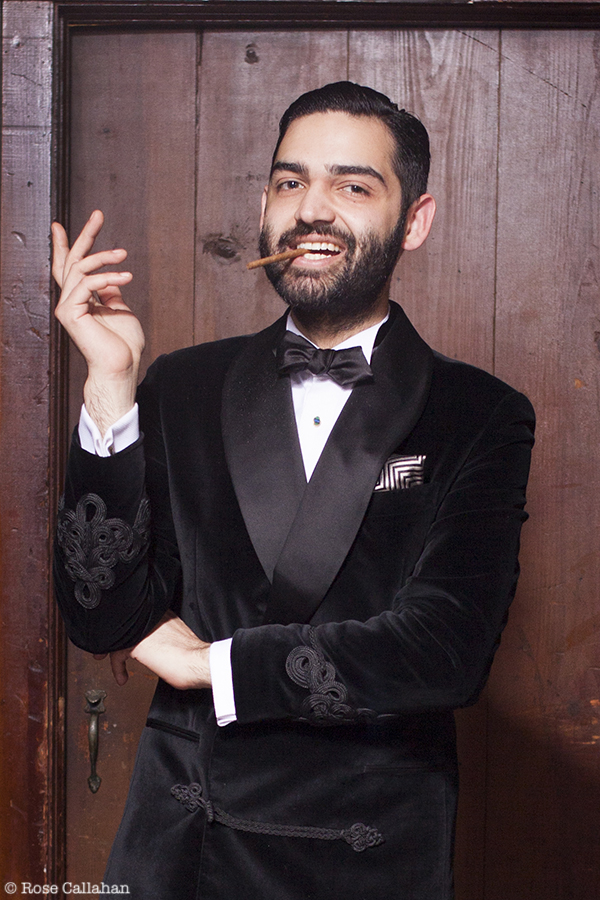
Nathaniel Adams, Amber “Hubba Hubba” Doyle, Mike Davis, Jake Mueser, or Dandy Wellington?

It appears that the event, Dandy Talk, fluffed by your faithful correspondent at the end of last month, went off without a hitch last Friday, October 5 in Gotham City. Presented by Rose Callahan, Matt Fox, Thomas P. Farley, David Zyla and Natty Adams, the event was attended by a veritable who’s who of Big Apple aesthetes, New Amsterdam dandizettes and boho bons vivants.

Among the dandiscenti were none other than fashionista Patrick McDonald (whose eyebrows must have come in a separate town car), menswear legend G. Bruce Boyer, our charming old nemesis, Allen Crawford (aka, Lord Whimsy), musician Dandy Wellington and designer Ignacio Quiles, among others.

Given the day-to-day sartorial splendor of these magnates of menswear, “who’s the dandy?” may seem a strange question to ask. So instead we’ll ask, “Mirror, mirror on the wall, who’s the dandy-most one of all?”

(more…)

Fine and Dandy: 5 Questions for Matt Fox

The Fine and Dandy Shop’s Matt Fox. Courtesy Rose Callahan.

It’s no wonder The Fine and Dandy Shop’s Matt Fox has a both a flair for the dramatic and a keen business sense. After graduating from Ithaca College in 1995 he moved to New York City to pursue a career theatre management, where he spent 12 years on Broadway managing Jujamcyn Theaters. Always interested in men’s style, Fox, along with his partner, Enrique, had fantasized about opening a men’s shop of their own. Intimidated by the potential start-up cost of opening a physical store in pricey Manhattan they, like many entrepreneurs in the 21st century, turned to the Web. “In 2008, given the explosion of menswear online from blogs to web stores (and sites like D.net) we decided to give it a try online,” says Fox. The Fine and Dandy Shop web store debuted shortly after, offering dandyish accessories for the young urban elite. It was both a stylistic and financial success. Fox left the theater in 2010 to concentrate on his e-commerce endeavor full time.

If publishing a hardback book is a kind of vindication for the blogger, then opening a brick-and-mortar shop must be something similar for the e-commerce entrepreneur. Suddenly, you’ve arrived. And The Fine and Dandy Shop is set to open in mid-town Manhattan later this fall. Fox, 38, has also been tapped to bring his knowledge of things dandiacal to an event entitled Dandy Talk this Friday, October 5 at the National Arts Club in New York City.

We recently sat down with Fox (virtually, at least) for a little dandy talk of our own.

(more…)

A Journal of Elegance: Monsieur Magazine

Editor’s Note: Dandyism is, of course, a calling that knows no borders. As Ellen Moers noted in “The Dandy: Brummell to Beerbohm,” after the fall of Napoleon, dandyism—and Brummell himself—leapt the Channel to France, where it took on a life and literature of its own, one that still thrives there today. From there Le Dandysme took flight, was translated into Russian, German and many other languages, and implanted itself into many customs.

In the spirit of that enlightenment—and in the spirit of “hands-across-the-sea”—Dandyism.net publishes its first article in French. In it, Pierre De Bonneuil, who publishes the French dandy site, La Loge D’Apollon, discusses Monsieur magazine, which began publication in 1919. Even if you don’t read French, you’re sure to enjoy this magazine’s marvelous—and very dandyesque—illustrations.

« Revue des élégances, des bonnes manières et de tout ce qui intéresse Monsieur »

Fondée en décembre 1919 au 4, rue de Tronchet à Paris, la revue procéda à une édition spécifique de son  premier numéro : un tirage de 100 exemplaires numérotés et signés par l’éditeur. C’est Jacques  Hébertot et Paul Poiret qui créèrent cet éloge du maintien et de l’esprit.

Dans sa présentation, Abel Hermant, rédacteur prolifique de la revue, évoquait l’esprit de Pétrone qui  considérait l’élégance pour l’une des catégories sous lesquelles on peut envisager tout ce qui existe  sans nulle exception. Ce périodique insuffla son exaspération à partir du numéro XIV en dernière couverture :  Monsieur n’est pas le Magazine des Snobs, c’est la Revue des Hommes Elégants.

Les écrivains des années folles élaborèrent des articles en estimant les variations du temps et en annonçant une érudition arbitraire sur l’essence élitiste. Ils signèrent des manuscrits savoureux où Monsieur rivalisait en distinction :

Un Dandy – Le Jeune homme bien élevé – Monsieur Reçoit – L’Elégance de l’esprit – L’Evolution du col – La cravate et la politique – De l’influence du chapeau sur la politesse – Gilets – Parfums pour messieurs – La chemiserie – Le veston – L’art de causer – les cannes – les mouchoirs – La bibliothèque de monsieur…

Les meilleurs illustrateurs de l’époque font du style un point d’honneur et une quête permanente de la beauté. Ils embellissaient l’ensemble éditorial. Voici une liste particulière de certains pinceaux : Eduardo Garcia Benito, Bernard Boutet de Monvel, Maurice Taquoy, Pierre Mourgue, Pierre Brissaud, André Pécoud, André Dignimont…

Cette revue devient, en quatre années, la référence absolue de l’homme au manièrisme intemporel dont le prestige est au prix d’une certaine lenteur et d’un mépris apparent de la médiocrité.

Pierre De Bonneuil

Illustrated Men: The L. Fellows Chronicles

1. Rupert

Rupert was finally determined to be ready if Peter once again brought up last summer in Capri.

Editor’s Note: L. Fellows is arguably one of the two greatest men’s fashion illustrators of all time, the other being J.C. Leyendecker. Unlike Leyendecker’s straight-up ads for Arrow brand shirts, however, every Fellows illustration seems to tell a story—the details of which are left up to the observer. One such observer is our own contributor, Robert Sacheli, the Passionate Spectator. Recently, on his Facebook page, Bob began posting his own, Saki-style vignettes based on 11 of Fellows’ most famous illustrations. They were so priceless that we asked to post them here on our home page. Please enjoy this, our first foray into the genre of illustrated novella. (Not familiar with Fellows? See Mr. Thompson’s superb write-up on the illustrious illustrator.) — M2

2. Everett

Since their arrival in Palm Beach, the only evidence that Everett had seen of Roy’s celebrated acting ability was the number of variations on a pout he could produce.

3. Elyot

That letter so carelessly tossed on the cabaña floor had freed Elyot from even pretending to care about Clifford’s choices in swimwear or companions.

(more…)

Dandies Past: Prince de Segan

It’s not often one happens upon a gem in the papers, especially one with something poignant and propitious to say about the body dandiacal. Well, at least not in the papers these days, anyway.

So we were pleased to stumble across, via a blog called The Esoteric Curiosa, a 1910 appreciation out of The New York Times of Charles Guillaume Frédéric Boson de Talleyrand-Périgord, more commonly known as the Prince de Segan.

Born in 1832, Talleyrand-Périgord, grew up to become a cavalry officer. That in itself is unremarkable, though it is telling. Like many a future dandy, Talleyrand-Périgord was an officer of horse, which, unlike the navy, the courts, or the clergy affords the kind of exercise that makes for a “well-turned leg,” while avoiding the drudgery of the infantry.

One cannot say that Talleyrand-Périgord, who became Duc de Segan in 1845 (and who was also Duc de Talleyrand, Duc de Périgord, and Duc de Valençay) rose to anything. He was born on high though in a country subject to constant (and sometimes deadly) revolution and change. Rather, he became the arbiter elegantarium of Parisian capital-S Society and its demi-monde — through power of style. As the anonymous author of the Times article writes:

It was the sovereignty of fashion — that is to say, of fashion in the broadest sense of the word, and in which the mere question of clothes played a very small part. He was no mere Beau Brummell, but rather an Alcibiades, in this sense, that he dictated the tastes, the prejudices, the fads, and the crazes of the hour. And not content with setting the fashion, he made people fashionable, for a briefer or a longer period, according to his caprice and his interest.

(more…)

Retrograde Empire: The Rise of the Retro-Eccentrics

Last night your correspondent went to the theatre to see a new play, “Maple and Vine,” put on by the American Conservatory Theater at the Curran in San Francisco. Written by Jordan Harrison and directed by Mark Rucker, the play – as the liner notes say – explores the lives of Katha and Ryu, who “have become allergic to their fast-paced modern lives. After they meet a charismatic man from a community of 1950’s re-enactors, they forsake cell phones and sushi for cigarettes and Tupperware parties. In this compulsively recreated world, Katha and Ryu are surprised by how much they are willing to sacrifice for happiness.”

That’s the pitch, anyway. The “charismatic man,” Dean, belongs to an organization called the Society of Dynamic Obsolescence – which may or may not be a not-so-subtle reference to the American quasi-medievalist Society for Creative Anachronism. The SDO, it turns out, owns a “Truman Show”-style gated community somewhere in the Midwest, which is permanently ensconced in the year 1955 – the era of Eisenhower, cars with fins, A-line skirts, mayonnaise slathered casseroles and Lucky Strike cigarettes. Everyone is expected to play their part and the community even has its own Authenticity Committee to enforce the retro “experience.” But, as in any good suburban melodrama – from “Babbitt” to “Lolita” to “Blue Velvet” – our heroes uncover the dark underbelly of their seemingly perfect and balanced “Ozzie and Harriet” community, replete with sexual repression and racism. In the end, Katha (now Cathy) and Ryu decide to stay on, while Dean, like a shunned Amish, eventually retreats to the outside world to pursue his gay lover.

(more…)

Ego Time: Dandies in the Press

We’re not ones to fluff our own egos. We have plenty of admirers to do that for us. However, once in a while the redoubtable Junta at D.net enjoys what can only be described as a perfect storm of kudos. This stretch of inclement weather has occurred in the last few months or, as the business types say, between the beginning of Q4, 2011 and the end of Q1, 2012.

It’s well known, of course, that our founder, Christian Chensvold, made it big in Japan with an eight page spread in the oddly-named style mag “Free & Easy.”

But, really, the big winner in the blogeratti kudos contest was decidedly Robert Sacheli, the Washington D.C. clubman-about-town who pens the occasional – and more than occasionally erudite – column, “The Passionate Spectator” herein.

On a junket to New York late last Autumn, your correspondent met Bob and Chenners at the delightfully haute-bohemian Coffee House Club on 44th Street’s club row. (Bob is a member and past president of the Arts Club of Washington, and the Coffee House is a reciprocal. If you don’t know what that means you are reading the wrong website.) There we had a delightful lunch among its charming membership. (Try the salmon. It’s divine.) Bob was looking smart but casual in a second-hand – we are not above that sort of thing around here, you know – Brioni sport coat and scarf.

After lunch, Bob wended his way down to the Village, where he was to meet with the fashion illustrator Richard Haines. On the street, he was stopped in his tracks by a photographer who snapped the picture above. This turned out to be a one Steffen Hendlund, who runs a style blog called “A Way of Dressing.”

Bob duly got his portrait drawn by Mr. Haines, right, here in a Richard James tweed hacking-style jacket with an orange velvet collar.

Earlier this year Bob was pigeonholed at a book party in D.C. for flowered shirt enthusiast and “Gay Men Don’t Get Fat” author, Simon Doonan. The shots (below) are from the GoKateShoot blog of D.C. photographer Kate Warren.

(more…)

Officially Unofficial: The Dandyism.net Armorial Achievement

Dandyism.net now has an officially unofficial armorial achievement, commonly referred to as a “coat-of-arms”—you can read about the all tedious distinctions and exact terminology for yourself  here if you are so inclined.

Why “officially unofficial?”  Because, as noble as D.net is, it has not petitioned, nor will it likely ever be granted, a patent from either the College of Arms of England or the Court of the Lord Lyon in Scotland. In these countries flashing the D.net achievement may put you at risk of getting the equivalent of a parking ticket from the heraldry police. Fair warning.

Never mind. We’re Americans—or at least three-quarters of the D.net Junta are—and are therefore free to append any image, tagline, motto, brandmark or what-have-you to our website that we choose.

Regardless of the legal niceties, the achievement, designed by redoubtable D.net contributor, heraldry buff, sartorial entrepreneur and style blogger, Bill Thompson, follows all the rules pertinent to the art and science of heraldry. The blazon, the written description that is the heart of any armorial achievement, reads as follows:

Gules, a coney Ermine saltant, an otter Ermines rampant contourné victualled Or, a chief wavy of the last guttèe du vin, a gillyflower Vert. Crest, an antique Eastern crown, a peacock close Proper. Mantled the first and Argent. Motto: “Chaque homme un roi.”

Within all this seemingly Harry Potter-esque lingo resides sound reasoning for each charge. The coney, or bunny rabbit, is sometimes a prankster but otherwise lives a quiet and peaceable life, while the otter is dining out (“victualled”) and living life to the fullest. Both are tinctured in luxuriant fur—ermine, once reserved only for royalty. The wavy partition connotes flânerie, while the chief, or field above, is  “scattered with drops of claret.” The “gillyflower vert” is as close an approximation of Oscar Wilde’s green carnation as the ancient rules of heraldry will allow. The peacock peeking out of the crown speaks for itself. What could be more dandiacal?

The motto, chaque homme un roi, roughly translates to “every man a king,” and harkens back to the life of Beau Brummell. (In case you’re worried, faithful myrmidons, our new motto may be chaque homme un roi but our venerable tagline remains “insufferably bored since 1802.”)

It occurs to us that our coney, our otter and our peacock will want names of their own. Have any ideas? Leave them in the comments. If we choose one or more of your names we’ll send you a D.net armorial achievement-themed keepsake.

Announcement

In recognition of Mr. Thompson’s exemplary service to Dandyism.net, the Junta is pleased to announce his elevation from faithful myrmidon to the august position of Minister of Protocol and Pursuivant of Arms, with all the rights and privileges thereunto.

And that’s official.

New Year, New Dandyism.net

Faithful myrmidons will have noticed that two new articles have recently been posted to the D.net homepage, our “Dandy of the Year”—which is more like “Dandy of the Every Other Year” at this point—and a piece on our former leader and ongoing inspiration, Christian Chensvold (blessings and peace be upon him) and his success in the ephemera of Japan. These are but a mere amuse-bouche for what is to come. On the slate are original monographs, profiles, interviews, book and museum reviews and much more. Stay tuned.

In addition, we’ve made some changes to the masthead:

Michael Mattis takes over as Grand Poo Bah, charged with the thankless but not entirely unrewarding tasks of Managing Editor and Forum Moderator. We encourage new viewers to become Forum myrmidons, and lapsed myrmidons to re-engage in the conversation. There is no entry fee and you have nothing to declare but your genius. We think you’ll like the changes. If you would like to try your hand at the quill and contribute an original article to the D.Net home page, please join the Forum and send Mattis a private message.

Florida gentleman and neo-royalist homme d’affaires, Sean Charles Hall, is our new Social Media Manager and Cruise Director. Hall created and now curates our elegant page on Facebook. There you’ll find a veritable boîte à bijoux of dandiacal imagery, bons mots, and exquisite conviviality.

Stewart Gibson has been named, sotto voce, as D.net’s Editor, Ephemera. For some time, the London boulevardier has been charged with the exclusive responsibility of making sure that there are three or four new Ephemera links each week.

And while you’ve been cramming so that you can pass the definite Test of Dandy Knowledge— finals are next week, gentlemen—more texts have been added to the Library.

(more…)

Laurence Fellows: Master of Menswear Illustration

spring342fx1.jpgIn the spring of 1934, a gentleman with a neatly trimmed mustache casts an eye in the direction of the door to an office waiting room, temporarily distracting him from the copy of Esquire he’s just picked up. Is he waiting for a stockbroker? A dentist? A divorce lawyer?

We can tell he’s a man of means and sophistication from his outfit. He’s sporting a lightweight double-breasted suit in a strong check pattern. His blue shirt has a starched white collar and cuffs, and his Guards tie is finished with a four-in-hand knot. His blue pocket square is a few shades paler than his shirt, and matches his socks. His shoes are brown cap-toe balmorals. A gray homburg and rattan cane have been casually placed on an adjoining chair.

Wearing a checked suit in town is something nearly unheard of, but this man pulls it off smashingly. We know he’s confident in his clothes and his world—because the world he inhabits is the creation of an artist who signs himself L. Fellows. And you can be sure that in the months after this illustration appeared, far more checked double-breasted suits were seen on city sidewalks.

If you’ve ever cracked open an old Apparel Arts magazine or vintage Esquire from the ’30s to the ’50s, you’ve seen the distinctive fashion art of Laurence Fellows. But who was this Fellows fellow, anyway?

Fellows was born in Ardmore, Pennsylvania in 1885. He was trained in illustration at the Pennsylvania Academy of Art, and honed his trademark “continental” style studying in England and France. But the real story begins when he returned to the States in the early 1910s and burst on the scene as an eager and talented young artist.

Fellows found work contributing to satirical magazines like Life and Leslie’s, and his European-influenced style was fresh and new, reflecting the sleekness and stylization that led to Art Deco. His work was so fresh, in fact, that he found many of his better-known contemporaries, including John Held, Jr. and Ralph Barton, were adapting his stylistic elements for their own use.

Fellows’ style during this period was very mannered and graphic, with thin black outlines enclosing flat expanses of tone and compositions that emphasized graphic weight and balance over fussy illustrative detail. His bread and butter throughout the 1920s was his work for the Kelly-Springfield Tire company. He brought an idea to the Kelly advertising manager for a series of magazine ads featuring “smart cars and smart types of people.” It was the beginning of an assignment that lasted for nearly a decade. The ads are still smart and fashionable today (and becoming collectible, by the way). (more…)

A Dandy in Embryo

c-3.jpeg

Eton, 1947.

Spot the Dandy

c-1.jpeg

 Sunday School in Lancaster, PA, 1941.