Personae

Count Your Blessings

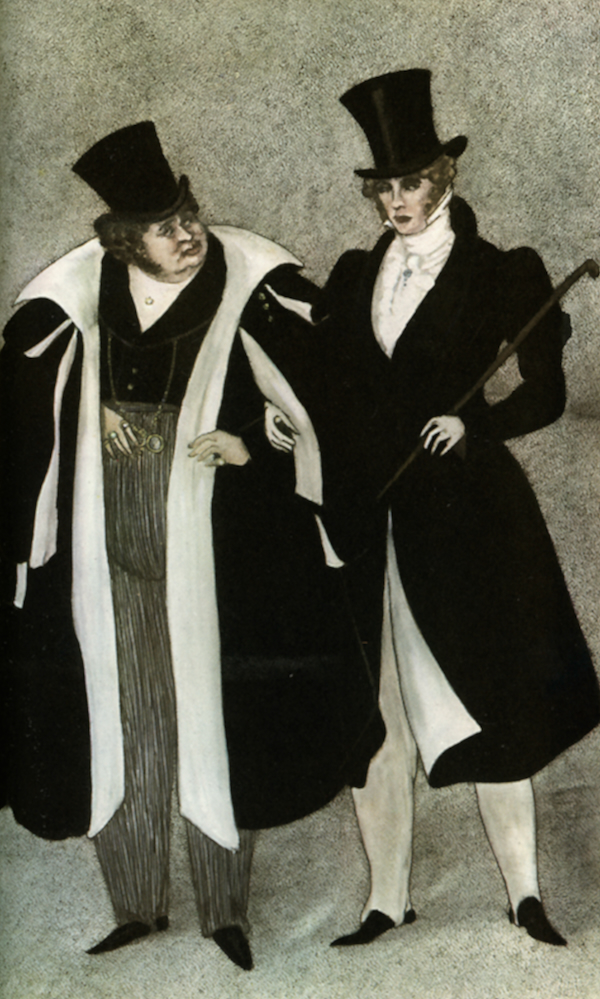
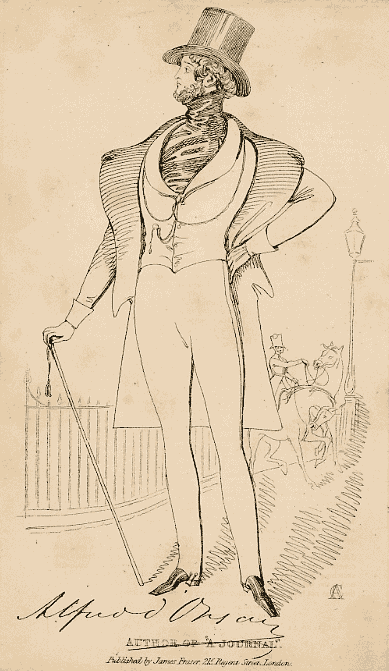
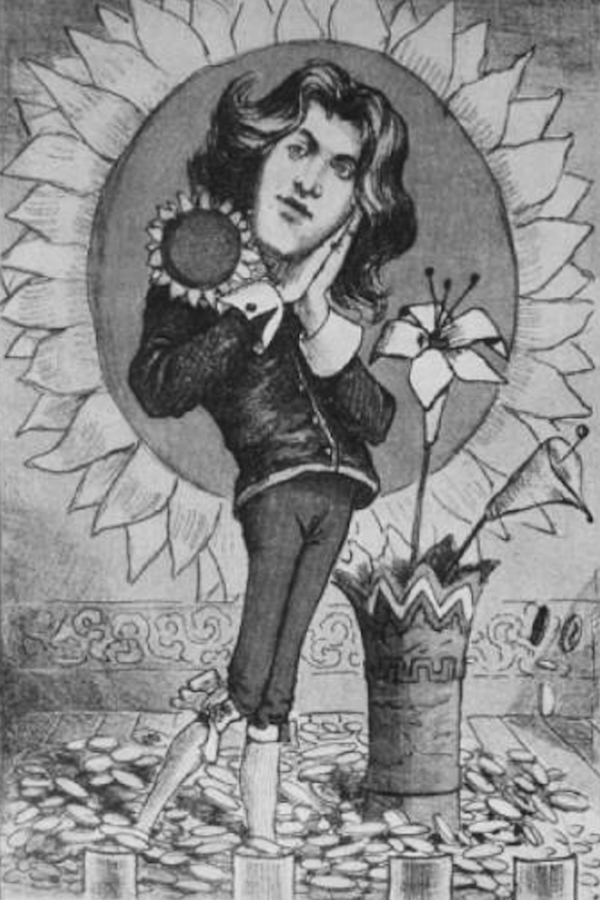
gcga_1989211615a_1_2.jpgIn 1844, at the height of his fame, Count Alfred d’Orsay found himself lampooned in print. Writing under the pen name A Man of Fashion, popular novelist John Mills published “D’Horsay: Or the Follies of the Day.” The whiff of scandal that ensued did little to obviate d’Orsay’s demand in society, perhaps because it failed to address the Count’s apparent seducing of wife, husband and daughter in the Blessington family.

However, the book was immediately suppressed for its attacks on prominent men of the day, who are depicted engaging in various acts of questionable morality.

“D’Horsay” is as tiresome and dated as one would expect, but we have excerpted a few descriptive passages for their historical value, as they show how the second-greatest dandy of all time was viewed in the diabolical monocle of a contemporary satirist.

Some descriptions are of the character D’Horsay, while others are of his sycophantic imitators. The great dandy caricaturist George Cruikshank supplied the drawing at left.

* * *

D’Horsay, or the Follies of the Day
by A Man of Fashion (John Mills), 1844

In the lower room of this house of counterfeit show, sat, or rather lounged, a leader of the votaries of pleasure. The Marquis D’Horsay was, indeed, “the glass of fashion, and the mold of form.”

From the color and tie of the kerchief which adorned his neck to the spurs ornamenting the heels of his patent boots, he was the original for countless copyists, particularly and collectively.

Even the brow which the ducal coronet occasionally pressed was proud to wear the hat imitated from the model, which every aspiring Tittlebat Titmouse of the age strove to copy in his gossamer. The hue and cut of his many faultless coats, the turn of his closely-fitting inexpressibles, the shade of his gloves, the knot of his scarf, were studied by the motley multitude with greater interest and avidity than objects more profitable and worthy of their regard, perchance, could possibly hope to obtain. Nor did the beard that flourished luxuriantly upon the delicate and nicely chiseled features of the Marquis escape the universal imitation.

Those who could not cultivate their scanty crops into the desirable arrangement had recourse to art and stratagem to supply the natural deficiency. Atkinson and Rowland revelled in the attempts. From the extreme east to the far west ends of London, lights and shadows of the Marquis were plentiful as daisies in merry May. Wristbands, both false and real, were turned over cuffs of every dye and texture, and, in short, from the most essential article of the modish lion’s dress to the most trifling, not an item was left confined to its pristine state of originality. (more…)

Unnatural Selection

a-rebours-cover-picture.jpgDedalus Books, publishers of such dandy classics as “The She-Devils” by Barbey d’Aurevilly and “Monsieur de Phocas” by Jean Lorrain, has put out a new edition of J.-K. Huysmans’ seminal work of French Decadence, “Against Nature.”

Released last week in the UK and this week in the US, the book features a new translation, introduction, bibliography in English, the celebrated preface by Huysmans written 20 years later, and extensive notes on the author’s obscure historical and cultural references.

It also features as a cover image a self-portrait by Egon Schiele looking like a LiveJournal blogger.

“‘Against Nature’ will be Dedalus’s seventh Huysmans title and the fourth book to be translated by Brendan King,” Dedalus founder Eric Lane told Dandyism.net. “Our edition will be the definitive edition of ‘Against Nature’ for the next 30 years. A classic text benefits from having new translations to keep it alive. It also reinforces its importance and reminds people that it is a book for today as yet another new translation has appeared.”

Below is an interview with Brendan King, a Paris-based writer and translator who recently completed his Ph.D. on Huysmans, and who runs the site Huysmans.org. Following that is a sample of King’s translation, including the “sermon on dandyism” passage in which Des Esseintes, the book’s hero, looks back on the sartorial follies of his youth.

(more…)

Ghost Writer: Lucius Beebe 3/3

bebe.jpgHerein follows the final chapter of Robert Sacheli’s biography of Lucius Beebe, which depicts the subject in his final years haunting the modern world like an elegant phantasm.

Sunset in San Francisco

The television show “Bonanza,” set in Virginia City, was a gold mine for the town, but this fictional version of old Nevada was at odds with Beebe’s more rarified vision, and in 1960 he and Charles Clegg decamped for San Francisco. The column “This Wild West” became his bully pulpit at the San Francisco Chronicle, and he continued to write for the glossy magazines that guided aspirants in the art of finer living, such as Gourmet, Holiday, and Town & Country.

Read the first and second installments of this article.

Beebe’s work of this period still reflects his wit, enthusiasms and indulgences, but the charm could now sometimes curdle and the nostalgia grow overbearing. Still renowned as the nation’s foremost “eatall and tosspot,” Beebe roamed the globe and reported on fabled restaurants, but his articles blur into an over-rich banquet of le hommard Deauvillaise, poularde sautee au Champagne, croustarde de langouste, and soufflé Grand Marnier, washed down with Chateau Margaux ‘34 and topped off with snifters of Hine cognac and a Cuban belicoso fino. Who, in the early 1960s, was dining like this?

(more…)

Steppin’ Out With My Beebe: Luscious Lucius Part Two

beebe-oval-2.jpeg

Here follows part two of Robert Sacheli’s resuscitation of the forgotten American dandy Lucius Beebe, in which the author pays particular attention to Beebe’s sartorial splendor and his place as the first retro-eccentric of modern dandyism.

Dressing for the role of official czar of Nightclubland came naturally to Lucius Beebe, as he’d been rehearsing for it all his life.

Beebe was reportedly the first man to introduce white linen plus-fours to Yale (Gibbs reported that “Professor Chauncey P. Tinker, seeing them at a distance, complained irritably that the place was getting overrun with women. ‘Don’t look now,’ he said, ‘but here come two of them now.’”) He got better reviews from his fellow students. The campus paper enthused over his “orchidaceous grey trousers” and “vine-covered top-hat.”

Read the first and third installments of this article.

In London, Beebe ordered his suits from Savile Row’s Henry Poole & Company, and he looked on being measured for a bespoke suit as something akin to taking the sacrament. The venerable gentleman’s tailor was “not only a cathedral of waistcoats and hunting pinks, [but] a repository of Victorian grandeurs establishing continuity with the past and the great names of English legend.” Throughout his life, his business suits from Poole duplicated the lines of one made for him in New York in the early ’20s, which were, he says, “cut from doomsday fabrics, with notched lapels and four buttons.” The suits were only one component of the grand effect. The New Yorker helpfully provided its readers with a partial inventory of Beebe’s dressing room:

He has a good evening dress coat lined with mink and collared in astrakhan, which he has insured for $3,000, and an old rag also lined in mink, but with a sable collar, which didn’t seem worth the bother. The jewels necessary to set off this splendor, or else hold it together, include three gold cigarette cases (although he rarely smokes anything but cigars), valued at $700 each [in 1937 dollars], a cashmere sapphire cabochon ring worth $1,200, a single emerald stud at $500, and a platinum evening watch which cost $10,000.

(more…)

Yes Sir, That’s Our Beebe

beebe-1.jpgWhen Dandyism.net launched four years ago, we stated as our mission the desire to rescue the dandy from the slag heap of history through rigorous scholarship and unflinching self-righteousness.

Now it is time to rescue one particular dandy: Lucius Beebe, an all-but-forgotten American original who barely warrants a mention by the academics of dandyism, who are more concerned with muddled abstractions like “performance” and “self-invention” than the tangible plumage of top hat and tails.

To Beebe, this plumage was essential as it was to Fred Astaire. In donning it, Beebe simultaneously defined himself, an era, and the new genre of celebrity journalism. His gold-headed cane cut a wide swath through stuffiness, social conventions, and hoi polloi (he was called a notorious “peasant baiter”). Beebe’s patrician style was unmatched, as was the notoriety his wardrobe brought him.

Read the second and third installments of this article.

During his lifetime he was equally as famous as the stars and socialites who populated the small and swank universe he called “crazy luxe,” but within a few years of his death in 1966 he all but disappeared from public memory.

“The Passionate Spectator” columnist and burgeoning staff biographer Robert Sacheli, whose appreciations of Noel Coward and Fred Astaire have brought D.net acclaim on the Web and in print from as far away as New Zealand, ransacked a bevy of buried texts on Lucius Beebe in preparation for what is certainly the freshest and most thorough account of the man written in many decades, which will be presented in three parts.

The Junta encourages its faithful myrmidons to join us in a toast to Sacheli for his assiduous research, and to a long-lost member of our fraternity.

Welcome back, Lucius. (more…)

(Mis)quote of the Week

m-m-boys.jpg“We are not Victorian dandies.” — Peter McGough

It doesn’t take much to spout one of D.net’s “Misquotes of the Week.” Take for example the simple declaration above in the March issue of Men’s Vogue.

Peter McGough is one-half of the artistic duo McDermott and McGough. Like Gilbert and George, the M&M boys compensate for their lack of talent and originality by donning eccentric personae and assuming the name of a law firm.

But whereas Gilbert & George wear boxy three-piece suits to contrast with the vulgarity of their oeuvre, McD & McG get dolled up in 19th-century garb as a way of blending life and art.

Predictably, critics have dubbed them dandies.

Equally predictably, McDermott and McGough are the darlings of the retro-eccentric set, those delicate creatures who don’t have the stomach for the dizzying complexity of modern life and retreat into a romanticized vision of the past.

We at D.net are made of sterner stuff. We believe that dandies must be contemporary and master their era. That’s why we quote Brummell and run articles about Regency toffs.

Thanks, Mr. McGough, for setting the record straight. You and Mr. McDermott are not Victorian dandies. You’re not any type of dandies at all.

Pity in Pink

pink-flannel-suit.jpgOften criticized as Dandyland’s Grand Inquisitors, Dandyism.net has taken a bold step toward coming to terms with dandyism in the new millennium by forging an international alliance with the pink panther pictured at left.

Or rather, he’s formed an alliance with us.

The chap in question is John Dodelande, the 18-year-old French wunderkind (if a Frenchman can be a wunderkind) who has taken le tout Paris by storm with his audacious fashion designs, as well as stylish furniture, retail boutiques, restaurants, yachts and literary publications.

That’s if you believe his publicist.

Doodles (our term of endearment for him) loves pink suits: He not only designs them, he actually wears them in public, including on the cover of his revolutionary magazine-cum-book, and all over his website, which includes periodic posts about dandyism.

Doodles has also invented Doodism, a sort of 21st-century combination of dandyism and dodos, along with the innovative concept “Wo Wi Wo,” which stands for “World With Words.”

With his youthful good looks, flamboyance, enterprising creativity, and Dada penchant for jabberwocky, Doodles has just eclipsed former Dandyland exile Doran Wittelsbach as frontrunner for 2008 Dandy of the Year.

Despite his sartorial judgment, Doodles’ dandy acumen is rapier-sharp: His website describes D.net as “Le meilleur site américain sur le dandysme.”

So when his factotum sought out an interview with us, we could hardly refuse. The French version appears here, while the English version follows below.

During the course of the interview, D.net’s Junta opined on a variety of subjects of interest primarily to ourselves. We also discovered that when translated into French, our dry understatement becomes riddled with exclamation points, the punctuation equivalent of Gallic gesticulations when speaking.

(more…)

The Return of Aubrey Weirdsley

img_02741.jpgTo paraphrase Schopenhauer, dandies are like drops of mist forming a rainbow in the sunlight. When one drop of water disappears, another comes to take its place.

So while Sebastian Horsley has been denied entry into the U.S, blogger aubrey_weirdsley has returned to Dandyland after a year in digital exile.

“I’ve had nothing to say and no wish to share,” writes Weirdsley in his first post. “But people contact me now and again and say that I am missed, and although I don’t give a rusty-badger-crap about being known to the general public, it is nice that some of the few people that I care about care about me as well.”

Now writing under the nom de plume The Dandiest, Mr. Weirdsley (aka Doran Wittelsbach) is known for his impressive image collection, handlebar mustache that is all handles and no bar, and penchant for goth girls still shy of 21. He also shares the dual ignominy of being both a practicing Satanist and a former Dandyism.net contributor.

Moreover, even the most claret-clouded reader can see by the photo above why dressing like Mr. Weirdsley gets you -5 points on the dandy quiz.

Weirdsley’s inaugural post also recounts a gesture sure to be lauded by fellow dandypunk Horsley (indeed the pair should found a Mutualp1010015000031.jpg Humiliation Society). It seems Mr. Weirdsley has recommitted himself to cause of dandyism by mortifying his flesh with the word “dandy.”

But since all great dandies go into exile, Mr. Weirdsley’s return makes him the leading candidate for 2008 Dandy of the Year.

No Courtesy From Old Men

gilbert_and_george_465x350.jpgSince the 1960s, artistic duo Gilbert & George have covered one another in gold paint, documented their drunkenness, and created elaborate photo montages combining religion, nudity (including their own), bodily fluids and racism. With titles like “Naked Shit Pictures,” their work isn’t what you would call pretty.

Some, however, have called it dandyism.

“Gilbert Prousch and George Passmore put themselves at the center of their artwork,” declaims San Francisco’s de Young Museum in connection with a retrospective that began last week. “Identifying as ‘living sculptures’ in art and daily life, they eliminate the distinction between artist and art.”

Recalling Oscar Wilde’s dictum “One should either be a work of art or wear a work of art,” Gilbert & George aspire to do both. The magazine Apollo includes them among “contemporary artists who dress unusually, drawing on a tradition of dandyism,” which, the magazine notes solemnly, “is at least 150 years old.”

(more…)

Windsor Not

panache.jpgForget the new Brummell and the next d’Orsay — a wannabe Duke of Windsor is roaming the streets of New York.

The man is Robert Rufino. He is Vice President of Creative Services and Visual Merchandising for Tiffany’s. In other words, a window dresser.

Rufino has twice graced the International Best-Dressed List and has been profiled by the New York Times and New York Magazine for his sartorial acumen.

But these days anyone with a good PR person can accomplish that; getting on D.net is something altogether more notorious.

What caught our diabolical monocle is the fact that Rufino fancies himself the new Windsor.

“I’m known to be a great dresser,” he says with a dandy’s forthright vanity. “I mean I love to dress. My friends call me ‘Duke.’ I’m obsessed with the Duke of Windsor.”

We have our doubts as to whether Rufino is really the Duke’s 21st-century avatar. We don’t doubt for a moment, however, that he’s obsessed with the momentary monarch.

(more…)

Dandy of the Year: Lapo Elkann

head-shot.jpgHe’s young, good-looking and extremely wealthy. He’s fluent in six languages and the very definition of cosmopolitan, having been born in New York, raised in Brazil, educated in England and France, and now once again living in Gotham. He’s the scion of Italy’s preeminent family (the Agnellis, not the Mafia), and is quintessentially Italian. Style and fashion are in his blood, thanks to his aunt Diane von Furstenberg. He’s linked with sleek cars and even sleeker women. Perennially named to the world’s best-dressed lists, he’s officially a GQ style icon.

But that’s not why Dandyism.net has chosen Lapo Edouard Elkann its first-ever Dandy of the Year.

D.net salutes Elkann because this year he returned from exile. All good dandies must go into exile, either to escape gambling debts or arrest. Brummell and Jimmy Walker did it. Oscar Wilde did it, but too late. The Duke of Windsor did it, but for love. Celebrities and wannabes like Sebastian Horsley don’t go into exile, they merely go to rehab or jail or — worst of all — don’t go away at all.

(more…)

Dancing Chic To Chic

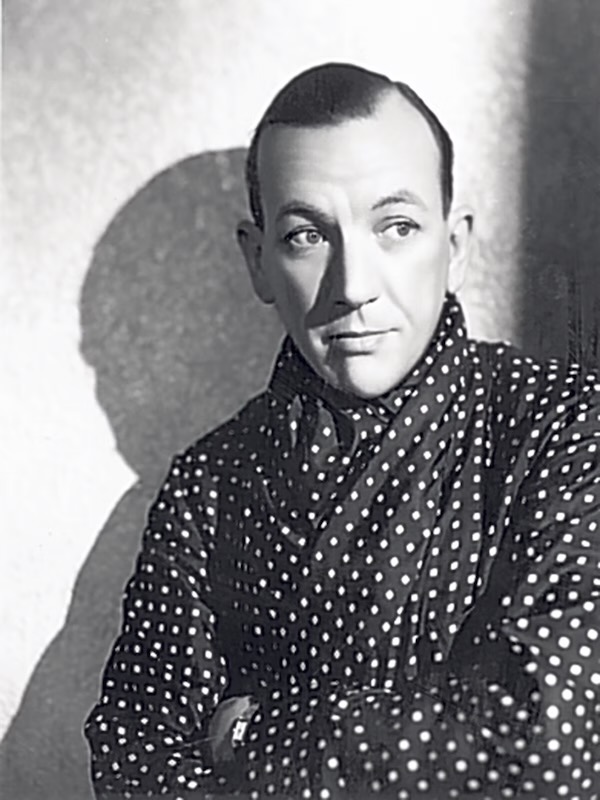
astaire.jpgFred Astaire lounges in a swank London flat, attired in a speckled dressing gown and cravat, musically daydreaming about the girl he’s just met. He’s smitten, but true to the plots of his films with Ginger Rogers, he doesn’t know the girl’s name.

So begins the “Needle in a Haystack” number from “The Gay Divorcée,” in which dressing becomes dancing and Fred Astaire becomes the superlative dandy in motion.

Drawn to the terrace doors by the line “I’ve got to find you,” Astaire’s reverie is interrupted by his valet, who presents a selection of ties and a mirror. Off comes the cravat and dressing gown. Astaire momentarily considers a tie, then selects another. After knotting it and fixing it in place with a tie bar, he absentmindedly begins to tap his suede shoes, still wondering where his anonymous crush might be.

Gradually the desultory taps expand into a dance that grows in scale and energy as Astaire dons each new item of clothing. On goes the suit jacket, the boutonniere is put in place, and suddenly he’s leaping over the sofa, bursting with optimism. The taps, increasing in intensity and rhythmic complexity along with Astaire’s resolve, propel him farther and farther, punctuated by a series of balletic beats.

The music and the movement reach their crescendo and Astaire is aloft again, gently landing atop the seat of zebra-striped chair, where he deftly catches a bowler and a furled umbrella from his man. Back on the floor, he bids goodbye to his valet with a gentle tip of his hat, then glides out the door to meet his destiny. He is a modern knight dressed for a quest, a man transformed by ardor, dance and fine tailoring into a new kind of romantic hero.

(more…)

Beyond the Fringe

copy-of-bunny-rogers-2.JPGNeil Munroe “Bunny” Roger is not a prominent dandy in the history of our fraternity. He’s what you could call a fringe dandy, and we mean that quite literally.

Bunny was just as likely to wear fringe and sequins as a coat and tie. For he was an old-school queen who loved to dress in drag and throw fabulous parties.

What saves Bunny him from being just another flaunting, excessive campy clown like Patrick McDonald was his genuinely good taste in conventional attire.

At least when he was young. When he got older, his Edwardian-infused sobriety combined with his drag-queen tendencies. Andrew Loog Oldham, the Rolling Stones’ version of Brian Epstein, remembers the Bunny of the early ’60s as “incredible.”

“His idol was Max Beerbohm,” recalls Oldham. “Bunny was unapproachably aloof, but I learnt enough from him by just looking. He paid meticulous attention to every detail of his appearance. Everything he did was a piss-take and a celebration. He looked almost 60, but he used to prance about in the most amazing three-piece chalk-striped suits. His jackets were so tightly waisted that they flared out like a skirt. The trousers were tighter than drainpipes and his shirts had high, rounded, stiff starched collars. His lips were permanently pursed, and he always wore a grey bowler hat, pearl tie pin, make-up, eyeliner and a carnation.”

After his death, Sotheby’s auctioned off Bunny’s entire wardrobe, including jackets exquisitely cut to show off his 29-inch waist. Bryan Ferry reputedly bid successfully on several of Roger’s pale blue, pink and lilac ties.

Roger also had a sharp, if campy, wit. Most of the twice-told tales involve his experience as a World War II soldier who wore chiffon scarves instead of fatigues, and whose weapon of choice was not a rifle but a rolled-up copy of Vogue.

Our favorite anecdote, however, occurred while Bunny was walking down a London street. A cab driver accosted him, “Watch out, luv, you’ve dropped your diamond necklace.” Roger shot back, “Diamonds with tweed? Never!”

So after some debate among the Junta, we’ve added a brief account of Bunny’s life (an oxymoron, since it’s his obituary) to The Library. You can read it here.

Jolly Roger

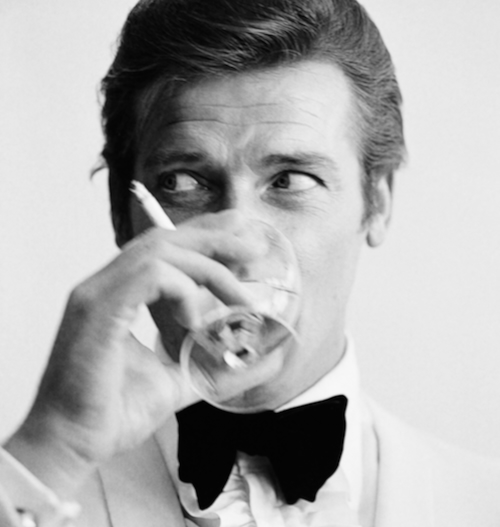
copy-of-roger-moore-1.jpgFor his 80th birthday last week, Sir Roger Moore received an appropriate present: A star on the Hollywood Walk of Fame. Moore attended the dedication dressed in a double-breasted blazer, gray flannels, white shirt, repp tie and bit loafers, proving he is truly a throwback to another era.

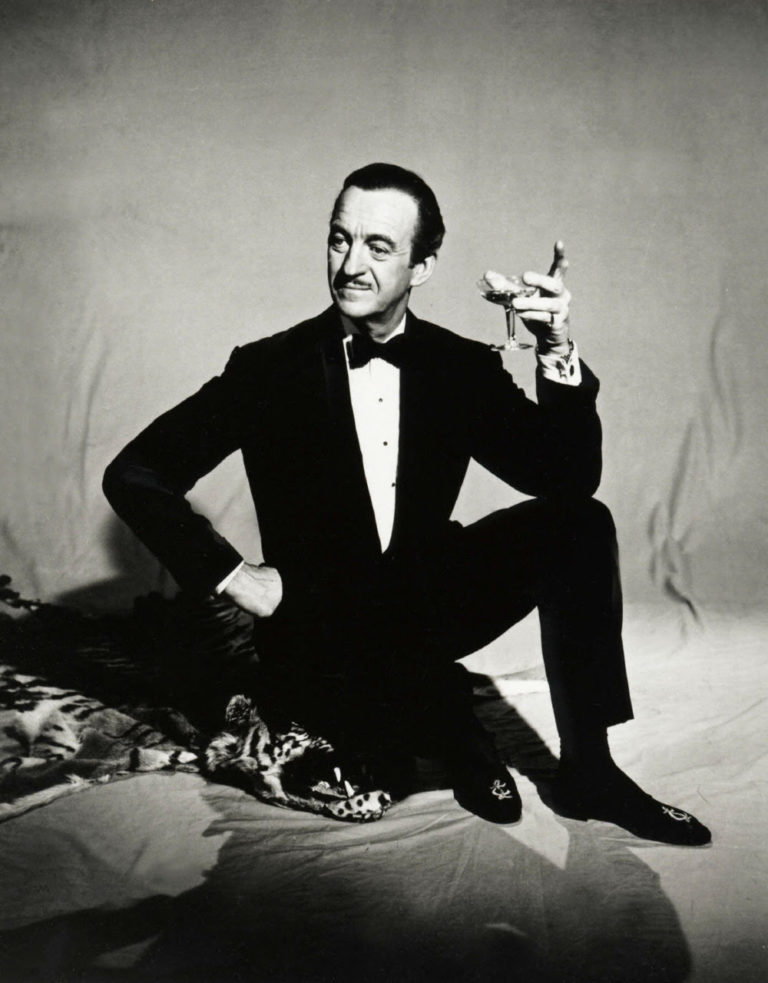
Moore, whose star neighbors that of Bugs Bunny, joins three other James Bond actors on the Walk of Fame: Pierce Brosnan, Barry Nelson and Sir David Niven. Bond actors who may or may not receive a star someday include George Lazenby, Timothy Dalton, Daniel Craig and Moore’s fellow Knight of the British Empire Sean Connery.

Moore has more good news: Next year he will release his autobiography (his publicist, naturally, will ghostwrite). Moore’s agent estimates that publication rights will fetch 2 million pounds, while industry pundits quote a probable price of 100,000 pounds. The working title is “My Word is My Bond.”

Roger Moore is best known for his seven James Bond films, spanning from “Live and Let Die” in 1973 to “A View to a Kill” in 1985. Yet his career features several other dandyish roles.

(more…)

I Lock The Door Upon Myself

fernand_khnopff.jpgIn 1900 Fernand Khnopff had a house built to his plans. It was a house without windows.

Silence and solitude were central themes in the work of the Belgian Symbolist, a truly unique figure in dandy genealogy who was both a reclusive artist and sought-after society man.

Khnopff’s home, a spectacular piece of artifice reminiscent of Ludwig II’s Neuschwanstein and the sanctuary of Des Esseintes in Huysmans’ “Against Nature,” was Khnopff’s “temple of the self.” Above the entrance door was inscribed his motto: “On n’a que soi” — one has only oneself.

Khnopff took the Brummellian (or rather Baudelairean) route of sartorial sobriety: “Beautiful red hair of a barbarian,” said poet Emile Verhaeren in describing Khnopff; “upright posture, neatly dressed, a simple person who had a horror of appearing disheveled; a clergyman in the process of becoming a dandy.” Historian Robert Delevoy writes that Khnopff displayed “narcissism, inside an armor of haughtiness, irony and scorn.” Amen to that.

Khnopff was briefly married. “Celibacy was his natural state,” writes Delevoy. In the 1930s, a decade after the artist’s death, his home was destroyed — with the approval of Khnopff’s family — to make way for an apartment building.

Dandyism.net webmaster Christian M. Chensvold recently posted a story on Khnopff, including an interview with a curator from the J. Paul Getty Museum, at his other site, FineArtsLA.com.

(more…)